Technique · October 15, 2026
By Justin Comstock · JazzValve creator, longtime guitarist and adult trumpet learner · Updated October 15, 2026
B-flat Trumpet Transposition: Concert to Written Pitch
Turn concert-pitch melodies and chord symbols into a B-flat trumpet part, with an octave-specific note chart and a playable two-bar check.
B-flat trumpet transposition has two directions: move concert notes up a whole step to find your written notes; move written notes down a whole step to find their concert sound. For example, concert C4 becomes written D4, while written C4 sounds concert B-flat3.
That rule helps you read a piano lead sheet, choose a backing track, and understand why a tuner displays a different letter from your trumpet part. Work through one short phrase before trying to transpose a whole tune.
First check which part you have
Written pitch is the note name on your B-flat trumpet part. Concert pitch is the sounding note, as named on a piano. A standard B-flat trumpet sounds a major second below its written notes, as explained in the Texas A&M-hosted Steps to Music Theory chapter on transposing instruments.
If your music is already labeled “Trumpet in B-flat” or “B-flat instruments,” play its written notes normally. Transposing that part upward again would change the intended music. If a digital chart has a concert/B-flat display switch, check which view is selected.
This lesson applies to a standard B-flat trumpet. A C trumpet and other trumpet types have different written-to-sounding relationships.
JazzValve
Practice This In JazzValve
Open in the app →
A concert-to-B-flat trumpet note chart
Read left to right when turning concert-pitch music into a trumpet part. Read right to left when telling a pianist what your written note sounds like.
| Concert pitch | Written B-flat trumpet pitch |
|---|---|
| C4 | D4 |
| D-flat4 | E-flat4 |
| D4 | E4 |
| E-flat4 | F4 |
| E4 | F-sharp4 |
| F4 | G4 |
| G-flat4 | A-flat4 |
| G4 | A4 |
| A-flat4 | B-flat4 |
| A4 | B4 |
| B-flat4 | C5 |
| B4 | C-sharp5 |
The octave number changes at C. That is why concert B-flat4 becomes written C5, rather than C4. Written C4 is middle C, one ledger line below the treble staff; C5 is third-space C.
Keep both the letter distance and the accidental correct. Concert E4 becomes F-sharp4: F-natural is only a half step higher. Concert B-flat4 becomes C5. You are raising the pitch by a major second, not simply copying the original flat or sharp onto the next letter.
Transpose one phrase, then test it
Here is an original two-bar exercise in 4/4. Set a metronome to quarter note = 60, and take a breath between repetitions.
Concert-pitch version for piano:
- Bar 1: E-flat4, G4, B-flat4, G4, all quarter notes.
- Bar 2: F4 quarter note, E-flat4 half note, quarter rest.
Written version for B-flat trumpet:
- Bar 1: F4, A4, C5, A4, all quarter notes.
- Bar 2: G4 quarter note, F4 half note, quarter rest.
Use fingerings 1, 1+2, open, 1+2 | open, 1. Here, a plus sign means press the valves together. These combinations agree with Yamaha's trumpet fingering chart.
Play the concert version on a piano if one is available, then answer on trumpet. The two versions should match in sounding pitch and rhythm. If C5 is not comfortable yet, practice just written F4–A4–G4–F4 as four quarter notes; the matching concert notes are E-flat4–G4–F4–E-flat4.
For more valve-reading help, see the Trumpet Fingering Guide.
JazzValve
Practice This In JazzValve
Open in the app →
Transpose chord symbols as well as melodies
On a concert-pitch lead sheet, move each chord root up a whole step and preserve its quality:
- Concert Cmaj7 becomes written Dmaj7.
- Concert Cm7 becomes written Dm7.
- Concert F7 becomes written G7.
- Concert B-flatmaj7 becomes written Cmaj7.
A concert Cm7–F7–B-flatmaj7 progression therefore becomes written Dm7–G7–Cmaj7. The pianist plays the concert symbols while you think from the written symbols; you are describing the same harmony.
For a slash chord, transpose the bass note too: concert F7/A becomes written G7/B. The slash means a specified bass note, so leaving it unchanged would describe a different chord.
Match the backing track and tuner
If a backing track is labeled in concert pitch, a concert B-flat major track matches written C major. A concert C minor track calls for written D minor. Major stays major and minor stays minor when you transpose.
Check a track's labeling rather than assuming every “B-flat trumpet” video uses the same naming system. The Trumpet Key Chart compares written major keys with their concert equivalents.
A tuner set to concert pitch should identify your written C4 as B-flat3. A tuner set to a B-flat instrument display may label that same sound C4. Check that setting before adjusting your instrument. An octave discrepancy also deserves attention: several open notes share the same fingering, so open valves alone do not prove you played the intended C.
Finish with a quick check: name a concert note, write the note a major second above it, then verify by moving back down. Start with concert E-flat, F, and B-flat. Your written answers are F, G, and C. Once those feel familiar, transpose one short phrase while keeping its rhythm unchanged.
JazzValve
Practice This In JazzValve
Open in the app →
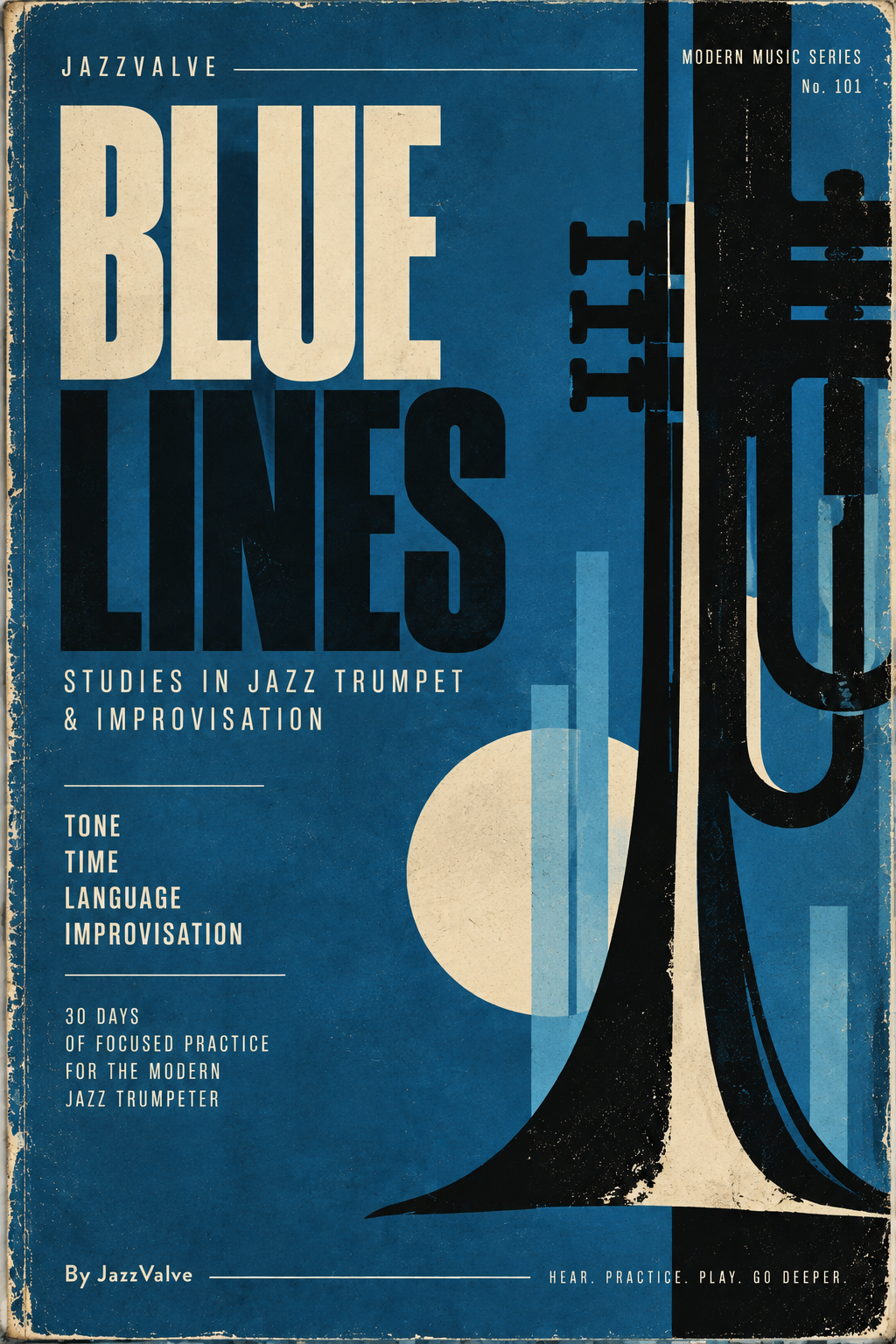
Free trumpet workbook
Blue Lines
Thirty days of focused B♭ trumpet practice: tone, time, jazz language and improvisation.
Sources
- Steps to Music Theory: Transposing Instruments — https://odp.library.tamu.edu/stepstomusictheory/chapter/transposing-instruments/
- Yamaha: Fingering diagram for the trumpet — https://www.yamaha.com/en/musical_instrument_guide/trumpet/play/play002.html