Scales · September 28, 2026
By Justin James · Jazz trumpet player and founder of JazzValve · Updated October 7, 2026
Jazz Trumpet Exercises: Turn One Scale Into Music
Start with written C Mixolydian, then turn eight notes into clean valve changes, swing phrases, and a short improvised answer.
I played the C Mixolydian cells on my B-flat trumpet at 60 beats per minute, listening closely to D–E. I noticed that keeping valve 1 down made it easier to focus on coordinating valves 2 and 3.
jazz trumpet exercises work best when you can play a short phrase immediately, hear its shape, and improve one detail. Start with written C Mixolydian: C, D, E, F, G, A, B-flat, C. Today, you will turn that scale into three playable patterns and a two-bar musical conversation.
You do not need speed or a high register. Instead, aim for a steady pulse, centered notes, and endings that sound deliberate.
Set up your notes and fingerings
All notes below are written pitches for B-flat trumpet, not concert pitches. Written C sounds concert B-flat, so use a concert B-flat dominant backing chord if you add accompaniment.
Begin on C4, the written C one ledger line below the treble staff. Finish on C5, in the third space.
| Written note | Valves | |---|---| | C4 | Open | | D4 | 1–3 | | E4 | 1–2 | | F4 | 1 | | G4 | Open | | A4 | 1–2 | | B-flat4 | 1 | | C5 | Open |
Valve 1 is nearest your mouthpiece. Press valves fully, and keep your fingers close to the buttons. For a quick reference, use Fingering for the Trumpet: A Practical Jazz Guide.
C Mixolydian differs from C major by one note: B-flat replaces B natural. That flattened seventh gives you the basic dominant-seventh color. Over written C7, listen for how B-flat contrasts with the steadier chord tones C, E, and G.
JazzValve
Practice This In JazzValve
Open in the app →
Three jazz trumpet exercises you can play now
Set a metronome to 60 beats per minute, with one click per quarter note. Play comfortably, then rest between repetitions. These jazz trumpet exercises share one scale, so your attention can move from finger coordination to phrasing.
1. Climb, pause, and descend
Play the following as quarter notes in 4/4. Each vertical line marks a bar:
C4 D4 E4 F4 | G4 A4 B-flat4 C5
Rest for one full bar. Then descend:
C5 B-flat4 A4 G4 | F4 E4 D4 C4
Use a light “doo” attack on each note. Keep the sound connected, but leave each pitch clearly defined.
On trumpet, the move from B-flat4 to C5 releases valve 1 while changing the vibrating pitch. If the upper C splashes, slow that pair down. Hear C before you play it, and avoid adding mouthpiece pressure to force the change.
Low D4 can also sound sharp. If your instrument has an adjustable third-valve slide, check D with a tuner and adjust as needed.
2. Repeat four-note cells
Now play these two bars as even eighth notes:
C4 D4 E4 G4, E4 D4 C4 D4 | E4 F4 G4 B-flat4, G4 F4 E4 C4
Each bar contains eight notes. Start evenly because this makes late valve changes easier to hear. Then try a relaxed swing feel without exaggerating every long-short pair.
Listen closely to D4–E4. Valve 1 stays down while valve 3 comes up and valve 2 goes down. If those changes arrive separately, you may hear an unwanted pitch between the notes.
Keep the air moving through the change. Your fingers should coordinate the notes, not interrupt the phrase.
JazzValve
Practice This In JazzValve
Open in the app →
3. Land on the third
Play G4, A4, B-flat4, G4 as four eighth notes on beats 1 and 2. Then hold E4 as a half note through beats 3 and 4.
Rest for the next bar, and repeat.
E is the major third of written C7. Therefore, landing there makes the line sound more connected to the harmony than simply stopping wherever your breath ends.
For more patterns using this sound, visit C Mixolydian Scale Trumpet Fingerings and Practice Drills.
Make the patterns sound like jazz
Listen to Miles Davis on “Freddie Freeloader” from Kind of Blue. Notice the space between phrases and how short ideas can carry a blues solo. These exercises are original practice patterns, not transcriptions of his playing.
Borrow that attention to space. Play exercise three as a call, then answer with E4, D4, C4. Give E and D one quarter note each, then hold C for two beats.
Next, change only the answer's rhythm. Keep the notes unchanged because fewer choices make it easier to hear whether your timing feels convincing.
Record one call and answer. Listen for a rushed opening, a clipped held note, or a final C that fades before the beat ends.
Finish with a focused practice loop
Spend two minutes on the scale, two on the eighth-note cells, and two on call and response. Include rests throughout. If your tone becomes strained, pause rather than drilling through fatigue.
Keep these jazz trumpet exercises in one key until you can play them without watching your fingers. Then open JazzValve’s C Mixolydian screen. Play C–D–E–F–G–A–B-flat–C, then use those notes for G–A–B-flat–G–E, holding the final E for two beats.
JazzValve
Practice This In JazzValve
Open in the app →
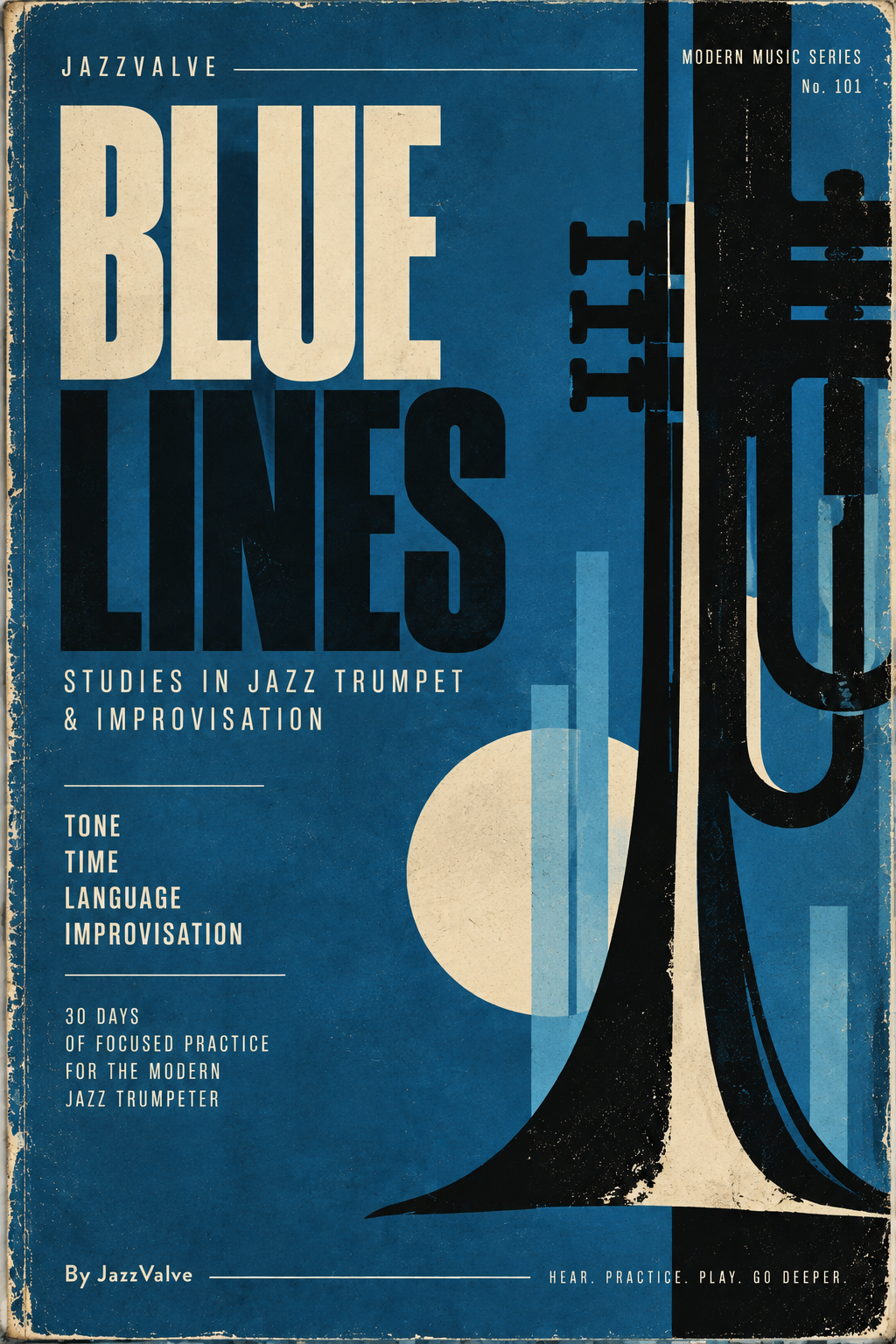
Free trumpet workbook
Blue Lines
Thirty days of focused B♭ trumpet practice: tone, time, jazz language and improvisation.