Technique · October 15, 2026
By Justin Comstock · JazzValve creator, longtime guitarist and adult trumpet learner · Updated October 15, 2026
Swing Eighth Notes on Trumpet: Count, Play, and Leave Space
Build a relaxed swing feel with three short trumpet exercises, clear counting, and deliberate rests. Written pitches stay between C4 and G4.
Swing eighth notes on trumpet start with a steady beat, a flexible subdivision, and enough space to hear what you played. You can practice all three with a few comfortable notes. Leave the high register and long scale runs for another session.
This lesson uses written pitches for B-flat trumpet. C4 is low C, one ledger line below the treble staff; it sounds concert B-flat3. Every exercise stays between written C4 and G4.
Count the beat before changing the eighths
Set a metronome to 80 beats per minute, with one click for each quarter note. Count four clicks per bar: “1, 2, 3, 4.” Keep tapping that pulse throughout the lesson, including during rests.
Straight eighths divide each beat into two equal parts. For an introductory swing approximation, divide it into three equal parts: “1-trip-let, 2-trip-let, 3-trip-let, 4-trip-let.” Start a sound on the number, sustain through “trip,” and start the second sound on “let.” Both sounds together still occupy one beat.
Treat that triplet model as a starting point. Swing does not have a universal 2:1 ratio. The spacing changes with the music and performer, and faster swing often approaches more even eighths. Open Music Theory’s swing lesson explains this distinction.
When counting “1-and-2-and,” place each “and” later than the halfway point for this first exercise. Keep the numbered beats steady. Do not delay the next beat to make room for an exaggerated swing.
JazzValve
Practice This In JazzValve
Open in the app →
Exercise 1: Make one note feel comfortable
Use written G4, the second line of the treble staff, with no valves pressed. If G4 is uncomfortable today, use written C4, also open.
Play this two-bar pattern in 4/4:
- Bar 1: eight swung eighth notes, all G4. Play two notes on each beat: 1-and, 2-and, 3-and, 4-and.
- Bar 2: a whole-bar rest lasting four quarter-note beats.
First sing the pattern on “doo,” then play it. Use a gentle tongue stroke to separate the repeated notes. Keep the sound easy and avoid punching every numbered beat. Count aloud during the silent bar and take a relaxed breath before repeating.
Play four cycles. Listen for four evenly spaced beats under the uneven eighths. If the last pair squeezes together, slow down or return to singing.
Exercise 2: Add a small melody
Use C4, D4, E4, and G4. Their standard fingerings are C4 open, D4 valves 1 and 3, E4 valves 1 and 2, and G4 open. The trumpet fingering guide is useful if a valve change distracts you from the rhythm.
Keep the metronome at 80. Each numbered item below occupies exactly one beat.
Bar 1:
- C4 then E4, two swung eighth notes
- G4, one quarter note
- E4 then D4, two swung eighth notes
- C4, one quarter note
Bar 2:
- Quarter rest
- C4 then E4, two swung eighth notes
- G4, one quarter note
- Quarter rest
Sustain each quarter note for its full beat in this exercise. Release into the rests cleanly, and keep counting while silent. Repeat the two bars three times, then take a longer break.
The quarter notes give your ear a clear reference for the pulse. If the valve changes make you rush, play the complete rhythm on G4 before restoring the melody.
JazzValve
Practice This In JazzValve
Open in the app →
Exercise 3: Enter after the beat
Now give the phrase a little breathing room at its beginning. Berklee’s “Got Rhythm?” lesson describes how rests, accents, and pitch help shape rhythmic phrases, and encourages practicing beginnings away from beat one.
Play this one-bar pattern in 4/4:
- Quarter rest
- Eighth rest followed by G4, one swung eighth note
- E4, one quarter note
- Quarter rest
In the triplet approximation, the beat-two rest occupies the first two triplet subdivisions. G4 enters on the final subdivision, the swung “and of two,” and leads into E4 on beat three. The rest follows the same subdivision as the notes.
Follow this bar with one complete bar of silence. Count both bars, then repeat four times. Avoid restarting your count when G4 enters: its entrance is still part of beat two.
Listen back before adding speed
Record one pass through each exercise. Check three things:
- Do the numbered beats remain evenly spaced?
- Can you hear every rest without losing the count?
- Does the melody sound connected, with clear, comfortable attacks?
Choose one issue to fix on the next pass. Then listen to a short swing recording and sing along with its phrasing. Let the recording refine the triplet approximation.
For a next step, apply this same steady counting and deliberate silence to the beginner call-and-response riffs. Keep the phrase small enough that you can hear its rhythm before you play it.
JazzValve
Practice This In JazzValve
Open in the app →
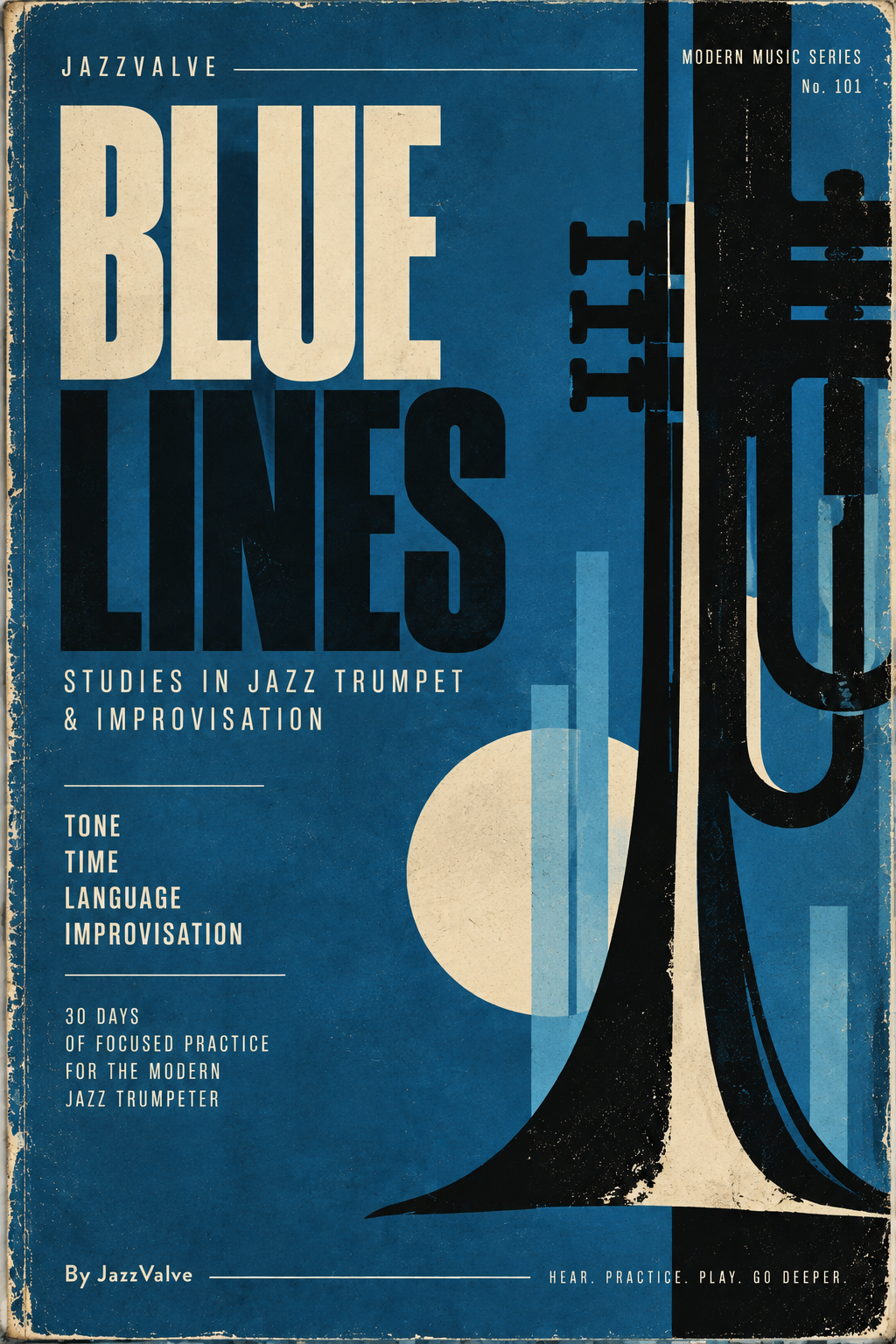
Free trumpet workbook
Blue Lines
Thirty days of focused B♭ trumpet practice: tone, time, jazz language and improvisation.
Sources
- Swing Rhythms – Open Music Theory — https://viva.pressbooks.pub/openmusictheory/chapter/swing-rhythms/
- Got Rhythm? – Berklee College of Music — https://college.berklee.edu/bt/193/lesson.html