Hard Bop · October 16, 2026
By Justin Comstock · JazzValve creator, longtime guitarist and adult trumpet learner · Updated October 16, 2026
12-Bar Blues on Trumpet: Count the Form and Keep Your Place
Learn a simple twelve-bar blues in written C for B-flat trumpet, with concert-key guidance, counted rests, and an original root-note study.
Knowing a blues scale and knowing where you are in a blues are two different skills. This lesson focuses on the second: hearing a twelve-bar chorus, keeping your place through rests, and arriving at the next chorus without guessing.
All notes for you to play are written for B-flat trumpet; the chart labels written and concert chord symbols separately. The exercise is in written C, which sounds in concert B-flat. Use a concert B-flat blues accompaniment that matches the simple changes below, not a concert C track. For a fuller explanation, see B-flat trumpet transposition.
Start with three groups of four
A twelve-bar blues in 4/4 contains twelve measures, with four quarter-note beats in each measure. One complete trip through those twelve bars is a chorus. The PBS Blues Classroom introduction explains the three four-bar sections and the I, IV, and V harmonic framework.
For this practice study, use the following basic three-chord version. It is a starting point, not the chord chart for every jazz blues recording.
| Bar | Written B-flat trumpet chord | Concert accompaniment chord |
|---|---|---|
| 1 | C7 | B-flat7 |
| 2 | C7 | B-flat7 |
| 3 | C7 | B-flat7 |
| 4 | C7 | B-flat7 |
| 5 | F7 | E-flat7 |
| 6 | F7 | E-flat7 |
| 7 | C7 | B-flat7 |
| 8 | C7 | B-flat7 |
| 9 | G7 | F7 |
| 10 | F7 | E-flat7 |
| 11 | C7 | B-flat7 |
| 12 | G7 | F7 |
The seventh chords add their own colors: written C7 contains C–E–G–B-flat; F7 contains F–A–C–E-flat; G7 contains G–B–D–F. These are chord spellings, not instructions to play four notes at once on the trumpet.
Think of bars 1–4 as the opening, bars 5–8 as a move away and back, and bars 9–12 as the route into the next chorus. Those descriptions help you remember this exercise's shape without replacing the actual chord symbols.
JazzValve
Practice This In JazzValve
Open in the app →
Count the form before playing
Set a metronome to quarter note = 60–80, at a speed you can count comfortably. Count each measure using its bar number on the first beat: “one, two, three, four”; then “two, two, three, four”; through “twelve, two, three, four.” Return immediately to bar one on the next beat.
Do two choruses without the trumpet. Point to the table as you count the first time. On the second, look up and say the chord root at bars 1, 5, 9, and 11: C, F, G, C. Continue counting through the other bars; do not add an extra beat while changing rows.
This is a map-reading exercise. A metronome supplies time but cannot tell you whether you have lost a bar. Recording your count lets you check whether each chorus contains exactly 48 quarter-note beats.
Play a sparse twelve-bar study
Use written C4, F4, and G4: middle C below the treble staff, F in the first space, and G on the second line. If that register is not comfortable yet, sing the exercise instead. The goal is learning the form, not extending your range.
In each bar, play the root of the written chord as a half note starting on beat 1, then rest on beats 3 and 4. For example, bar 1 is C4 for two beats followed by two beats of silence. Bar 5 uses F4; bar 9 uses G4. Follow all twelve rows of the chart.
Play one chorus, then put the horn down and count one complete chorus. Start the next played chorus on time. Keep the rests intentional: they are part of the exercise, not permission to stop counting.
Now make the task harder by playing only bars 1, 5, 9, and 11. Keep every other bar silent. The four entries should arrive in the same places as before. If they drift, return to one root per bar rather than adding more notes.
JazzValve
Practice This In JazzValve
Open in the app →
Give the chorus a musical shape
Once you can keep your place, try this original variation. At bars 1, 5, and 9, play the chord's root as a quarter note on beat 1, repeat it on beat 2, then rest for beats 3 and 4. Leave bars 2–4, 6–8, and 10–12 silent while continuing to count. Your three short statements now mark the three four-bar sections.
On the next chorus, keep the first two statements the same and change only the last statement's rhythm: a quarter rest on beat 1, the root as a quarter note on beat 2, then a half rest. Each bar still adds up to four beats. You have changed an idea without changing the length of the form.
The Jazz in America student lesson on blues describes the familiar statement, repeated statement, and contrasting response pattern. You can explore that broad phrasing idea without copying a melody or filling every space.
When a recording uses different changes
A blues can include a quick move to IV in bar 2, ii–V progressions, or other substitutions. Do not force this beginner chart onto a recording whose changes differ. Confirm the arrangement's chart and concert key first. Count its twelve-bar structure while listening before trying to match the harmony.
If you lose your place, stop playing, listen, and rejoin at a landmark you can identify. Adding louder or faster notes will not fix uncertainty about the bar number. Start again with fewer entries and a clearer count.
When the form feels steady, bring a short phrase from the written C blues scale lesson into one four-bar section. Keep the other sections sparse. For another focused practice resource, Blue Lines is a free jazz trumpet workbook available with email signup.
Finish by recording two choruses. Check three things: exactly twelve bars each time, no extra beat at the repeat, and deliberate silence between phrases. That is a more useful first goal than playing all the notes you know.
JazzValve
Practice This In JazzValve
Open in the app →
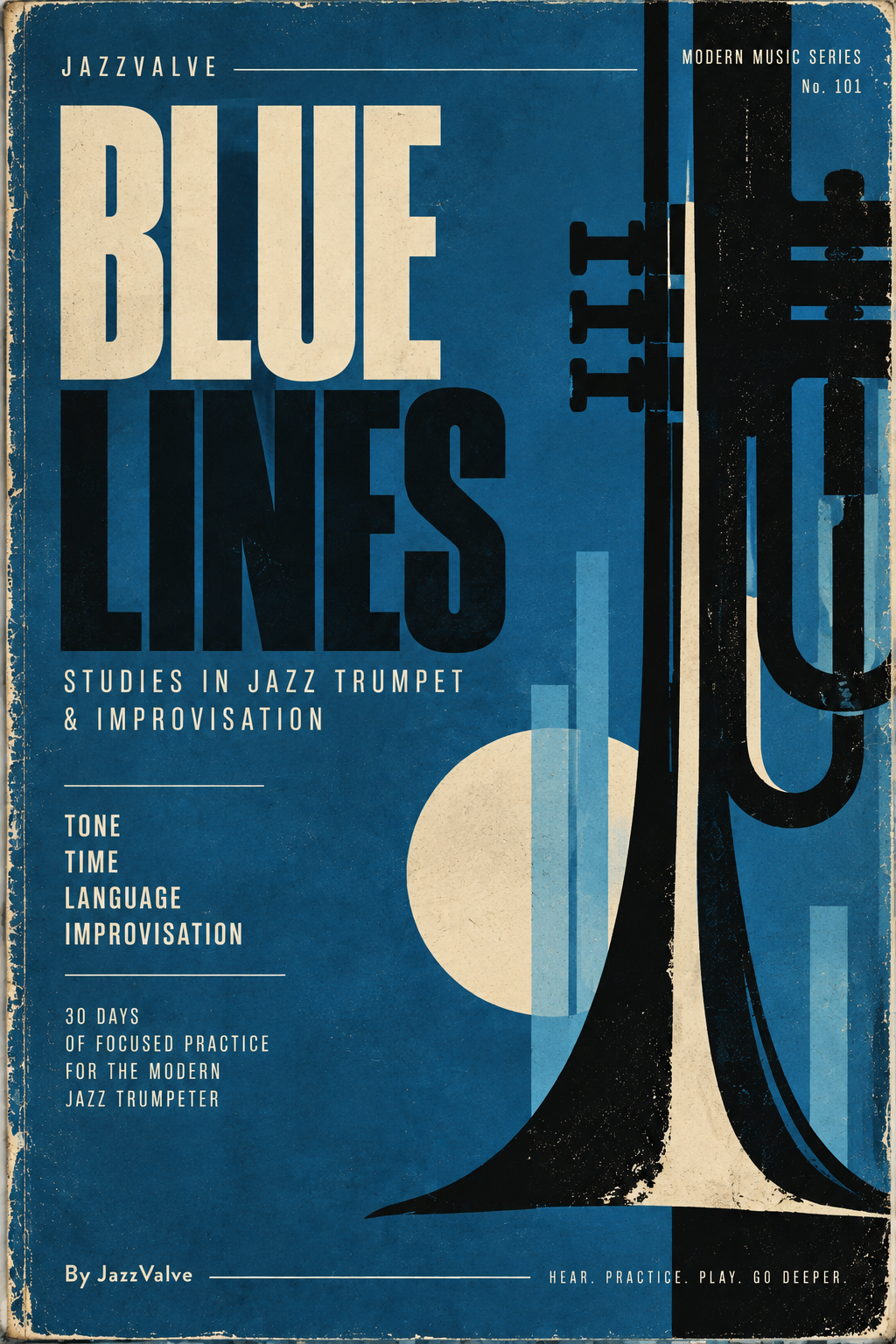
Free trumpet workbook
Blue Lines
Thirty days of focused B♭ trumpet practice: tone, time, jazz language and improvisation.
Sources
- PBS Blues Classroom: Understanding the 12-Bar Blues — https://www.pbs.org/theblues/classroom/essays12bar.html
- Jazz in America: Student Handout, Unit 3 — https://jazzinamerica.org/StudentHandout/5/3