Technique · October 21, 2026
By Justin Comstock · JazzValve creator, longtime guitarist and adult trumpet learner · Updated October 21, 2026
Jazz Ballad on Trumpet: Slow Pulse and Clear Phrasing
Work on sustained sound, planned breaths, and melodic shape with an original eight-bar jazz ballad study for B-flat trumpet.

Free trumpet workbook
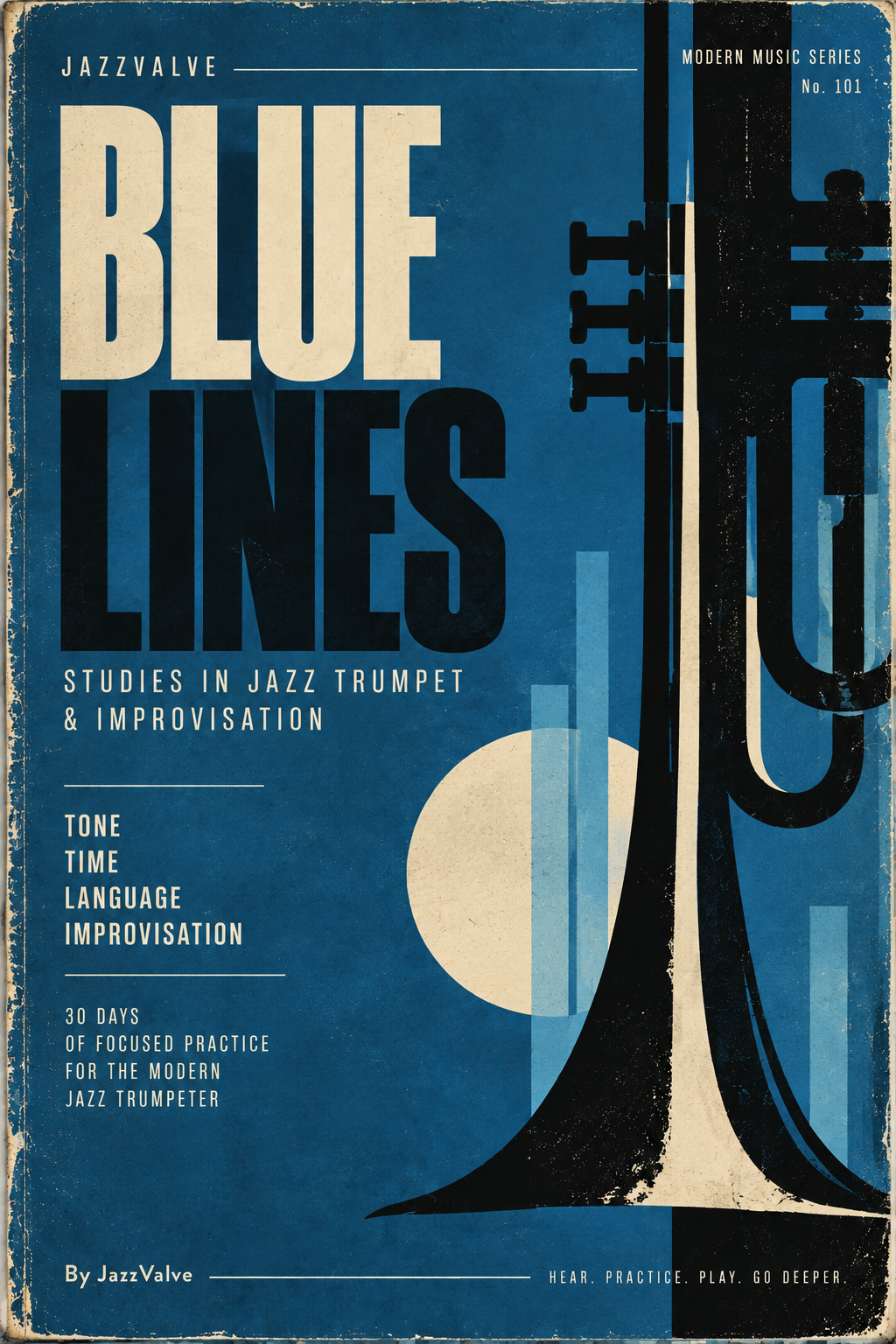
Blue Lines
Thirty days of focused B♭ trumpet practice: tone, time, jazz language and improvisation.
Email signup required
Get Blue Lines freeA jazz ballad gives each trumpet note time to be heard. That makes the beginning, the sustained sound, and the release part of the phrase. Slow playing also gives you more room to lose the pulse if you stop counting between attacks.
Start with a short melody and a dependable beat. This lesson uses an original eight-bar study to practice sustaining without sagging, breathing without adding time, and changing a phrase without losing its outline.
Keep a pulse inside the long notes
Open Studio's Elements of Jazz Piano workbook, in its ballad time lesson, emphasizes a secure underlying groove at a slow tempo. The same listening priority is useful for trumpet: a held note does not suspend the bar count.
Set a metronome to quarter note = 60 in 4/4. Count “1, 2, 3, 4” for two bars before playing. Keep that pulse going during every note and rest.
If the gaps between clicks feel hard to judge, temporarily use an even eighth-note subdivision. With a plain click at 120 clicks per minute, hear alternate clicks as “1, and, 2, and, 3, and, 4, and.” The music is still at quarter note = 60. You have added information between the beats, not doubled the musical tempo.
Use either the metronome's subdivision feature at 60 or a plain click at 120, not both. Return to one click per quarter note after the entrances become secure.
JazzValve
Practice This In JazzValve
Open in the app →
Prepare the sound before shaping it
All exercise notes are written for B-flat trumpet. Written C4 is the ledger-line C below the staff; G4 is the second-line G. They sound concert B-flat3 and F4. B-flat trumpet's major-second transposition is documented in UTEP's instrument reference.
After your normal warm-up, play written E4 as a half note on beats 1–2, then rest on beats 3–4. Repeat with G4, then C4. Use an easy middle dynamic rather than your quietest possible sound.
Listen for an even tone through both beats. Release when beat 3 arrives instead of letting the note dwindle until the sound stops unpredictably. Jeff Conner's trumpet teaching advice for Yamaha recommends steady airflow through sustained notes and changes of pitch. Here, use that as a simple listening goal, not an endurance test.
If the sound becomes strained, stop and rest. Making the exercise slower also makes each note longer, so a slower metronome setting is not always the easier choice.
Play an eight-bar ballad study
Learn this original melody without accompaniment. Use 4/4 at quarter note = 60. A half note lasts two beats; a dotted half note lasts three. Every bar below totals four beats, including its rests.
- E4 half note on 1–2; G4 quarter on 3; E4 quarter on 4.
- D4 half note on 1–2; C4 quarter on 3; quarter rest on 4.
- G4 dotted half note on 1–2–3; E4 quarter on 4.
- D4 half note on 1–2; half rest on 3–4.
- Quarter rest on 1; E4 quarter on 2; G4 half note on 3–4.
- E4 half note on 1–2; D4 quarter on 3; quarter rest on 4.
- E4 quarter on 1; G4 quarter on 2; E4 quarter on 3; D4 quarter on 4.
- C4 half note on 1–2; half rest on 3–4.
Take a breath during the written rests as needed. Bar 4's two-beat rest continues into the one-beat rest at the beginning of bar 5. Count all three silent beats before the E4 entrance. Do not turn that opening rest into a new count-in.
Lightly tongue each note on the first pass. Keep the longer notes connected internally, without adding pulses of air to mark the metronome clicks. Then try slurring E4 to G4 in bar 1 while lightly tonguing the following E4. Compare the connection without changing the rhythm.
The study uses a small written C-major note collection, but it is not a published standard or a substitute chord chart. Keep it unaccompanied while learning the phrase lengths.
JazzValve
Practice This In JazzValve
Open in the app →
Give the melody a destination
Play bars 1–2 as one phrase. Let G4 in bar 1 be its gentle high point, then settle toward the C4 in bar 2. A slight dynamic change is enough. Keep the written durations intact rather than stretching every note that feels expressive.
Next, compare bars 3–4. The long G4 creates a different shape from the earlier moving notes. Keep listening through its third beat so the E4 on beat 4 arrives deliberately rather than as a last-second correction.
Record the two phrases separately. Ask whether their shapes sound different even without changing tempo. If they do not, adjust one dynamic or articulation choice before adding extra notes.
The jazz articulation exercises offer shorter comparisons if a particular note connection keeps interrupting the sound.
Add one small embellishment
Change only bar 6. Keep E4 as a half note on beats 1–2. On beat 3, play D4 and C4 as two even eighth notes. Keep beat 4 silent.
This variation adds one note without changing the phrase's ending or the next entrance. Sing it first, then compare it with the original bar. If the extra note makes you rush, remove it and restore the quarter-note D4.
The even eighths are a deliberate choice for this study. A ballad's tempo alone does not tell you how every subdivision should sound. When learning an actual tune, follow the arrangement and listen to the players' phrasing rather than applying one swing formula to everything.
Save more flexible timing for later. Delaying a melody note expressively while the accompaniment keeps time requires a clear sense of where that time is. For this session, make the rhythm reliable before moving entrances around it.
Finish with a complete performance
Play all eight bars once without stopping to repair mistakes, then rest while you listen back. Check the release in bar 2, the long note in bar 3, the delayed entrance in bar 5, and the final two silent beats.
Choose one issue for the next attempt. You do not need to fix sound, articulation, dynamics, and timing simultaneously.
When you return to a ballad from your repertoire, sing its melody before playing and mark sensible breath points on your own chart. Preserve its form and chord changes as you experiment. The motif-development lesson can help you change a small idea while leaving enough of it intact for the listener to recognize.
For additional short daily material, the free Blue Lines workbook is available with email signup.
JazzValve
Practice This In JazzValve
Open in the app →
Free trumpet workbook
Blue Lines
Thirty days of focused B♭ trumpet practice: tone, time, jazz language and improvisation.
Email signup required
Get Blue Lines freeSources
- Open Studio: Elements of Jazz Piano, Time for When I Fall in Love — https://www.openstudiojazz.com/wp-content/uploads/2023/11/Workbook-3.pdf#page=94
- Jeff Conner, Yamaha: Fix It: Trumpet Teaching Tips — https://hub.yamaha.com/music-educators/instruments/winds-instruments/trumpet-pedagogy/
- Charles Leinberger, UTEP: Instrument Transpositions for Musical Analysis — https://utminers.utep.edu/charlesl/transpose.html