Technique · October 17, 2026
By Justin Comstock · JazzValve creator, longtime guitarist and adult trumpet learner · Updated October 17, 2026
How to Read Jazz Chord Symbols on Trumpet: C7, Cmaj7 and Cm7
Read C7, Cmaj7, and Cm7 on a B-flat trumpet chart, hear the notes that change, and practice an original six-bar chord-tone study.
C7, Cmaj7, and Cm7 share a root, but they ask for different notes. Start by learning which notes change. Then play a short phrase that makes the difference audible.
This guide uses written pitches and chord symbols for B-flat trumpet throughout the exercises. Written C sounds concert B-flat, a whole tone lower. The concert equivalents appear in a separate column below so you can match a piano or accompaniment. If your chart is already a B-flat trumpet part, read its symbols directly. For a concert-pitch chart, use the B-flat trumpet transposition guide before playing.
Read the root, then the chord quality
The letter names the root. The suffix tells you the chord quality. On trumpet, you can outline those notes one at a time as an arpeggio or use selected chord tones in a melody.
| Written chord | Say it | Written chord tones | Concert equivalent |
|---|---|---|---|
| C7 | C dominant seventh | C, E, G, B-flat | B-flat7 |
| Cmaj7 | C major seventh | C, E, G, B natural | B-flatmaj7 |
| Cm7 | C minor seventh | C, E-flat, G, B-flat | B-flatm7 |
Notice two small changes:
- C7 to Cmaj7: keep C, E, and G; raise B-flat to B natural.
- C7 to Cm7: keep C, G, and B-flat; lower E to E-flat.
A plain 7 after the root means a dominant seventh chord. For Cmaj7, “maj” identifies the major seventh. In Cm7, “m” identifies the minor chord quality; its seventh is B-flat. You may also see minor written as “min,” “mi,” or a minus sign, as in C−7.
Jonathan Feist's Berklee guide to lead sheets explains these symbol conventions. Different publishers use different abbreviations, so check the chart's notation rather than guessing from the typeface.
JazzValve
Practice This In JazzValve
Open in the app →
Give each symbol a sound
Use this written register: C4 is middle C on the ledger line below the treble staff; E4 is the first-line E; G4 is the second-line G; B4 is the middle-line B. E-flat4 and B-flat4 occupy the same staff positions as their natural versions, with flats.
At a comfortable volume, play these four-note groups slowly:
- C7: C4–E4–G4–B-flat4
- Cmaj7: C4–E4–G4–B4
- Cm7: C4–E-flat4–G4–B-flat4
Keep the root and fifth consistent so you can hear the changed third or seventh. If the upper notes are not comfortable yet, sing the groups or listen to them on a keyboard instead of forcing the range. Remember to use the concert equivalents when entering notes into an ordinary concert-pitch keyboard.
The C major triad lesson can help with the shared C–E–G shape. Adding the seventh gives you one more note to recognize, not a requirement to use all four notes in every phrase.
Play a six-bar comparison
Here is an original study in 4/4. Set the metronome to quarter note = 60, with a click on every beat. Each note in a played bar lasts one quarter note. Every rest bar contains four silent beats.
| Bar | Written chord | Beats 1, 2, 3, 4 |
|---|---|---|
| 1 | C7 | C4, E4, G4, B-flat4 |
| 2 | C7 | Rest for all four beats |
| 3 | Cmaj7 | C4, E4, G4, B4 |
| 4 | Cmaj7 | Rest for all four beats |
| 5 | Cm7 | C4, E-flat4, G4, B-flat4 |
| 6 | Cm7 | Rest for all four beats |
Use the silent bars to breathe and name the next chord. Keep counting while you prepare. This is a chord-quality comparison, rather than the changes of a jazz standard.
If you add accompaniment, hold each concert chord for two bars: B-flat7, B-flatmaj7, then B-flatm7. A generic B-flat blues track will not match all three qualities. You can do the entire exercise with the metronome alone.
Repeat once, listening specifically for B-flat becoming B natural in bar 3. On the next pass, listen for E becoming E-flat in bar 5. Record a pass and check those two places before increasing the tempo.
JazzValve
Practice This In JazzValve
Open in the app →
Turn the comparison into a phrase
Keep the six-bar layout, including the silent bars. Replace each four-note arpeggio with this rhythm:
- Beat 1: quarter rest
- Beat 2: the chord's third as a quarter note
- Beats 3–4: the chord's seventh as a half note
That gives you E4–B-flat4 for C7, E4–B4 for Cmaj7, and E-flat4–B-flat4 for Cm7. The opening rest, quarter note, and half note add up to four beats. Start counting before you play so the rest has a clear place.
Now change just one element: repeat the third on beat 3 and play the seventh on beat 4, both as quarter notes. The notes still identify the same chord while the rhythm gives the phrase a different shape.
Read a real chart in small steps
Choose one measure from a chart you are learning. Confirm whether its symbols are concert pitch or written for B-flat trumpet, then say the root and quality aloud. Write down the chord tones and choose two you can play comfortably. Check where the next chord begins; some measures contain more than one chord.
For this first reading exercise, work with a plain seventh chord. Symbols such as m7(b5), dim7, sus, and altered dominants need additional information. Save those for a separate step rather than treating every seventh chord as one of today's three examples.
Once you can identify the third and seventh without stopping, try the ii–V–I guide-tone lesson. It puts those notes into a moving progression.
For another short practice resource, Blue Lines is a free jazz trumpet workbook available with email signup.
Finish by covering the note column in the first table. Name and play each chord from its symbol. If one note is uncertain, that is your next practice target.
JazzValve
Practice This In JazzValve
Open in the app →
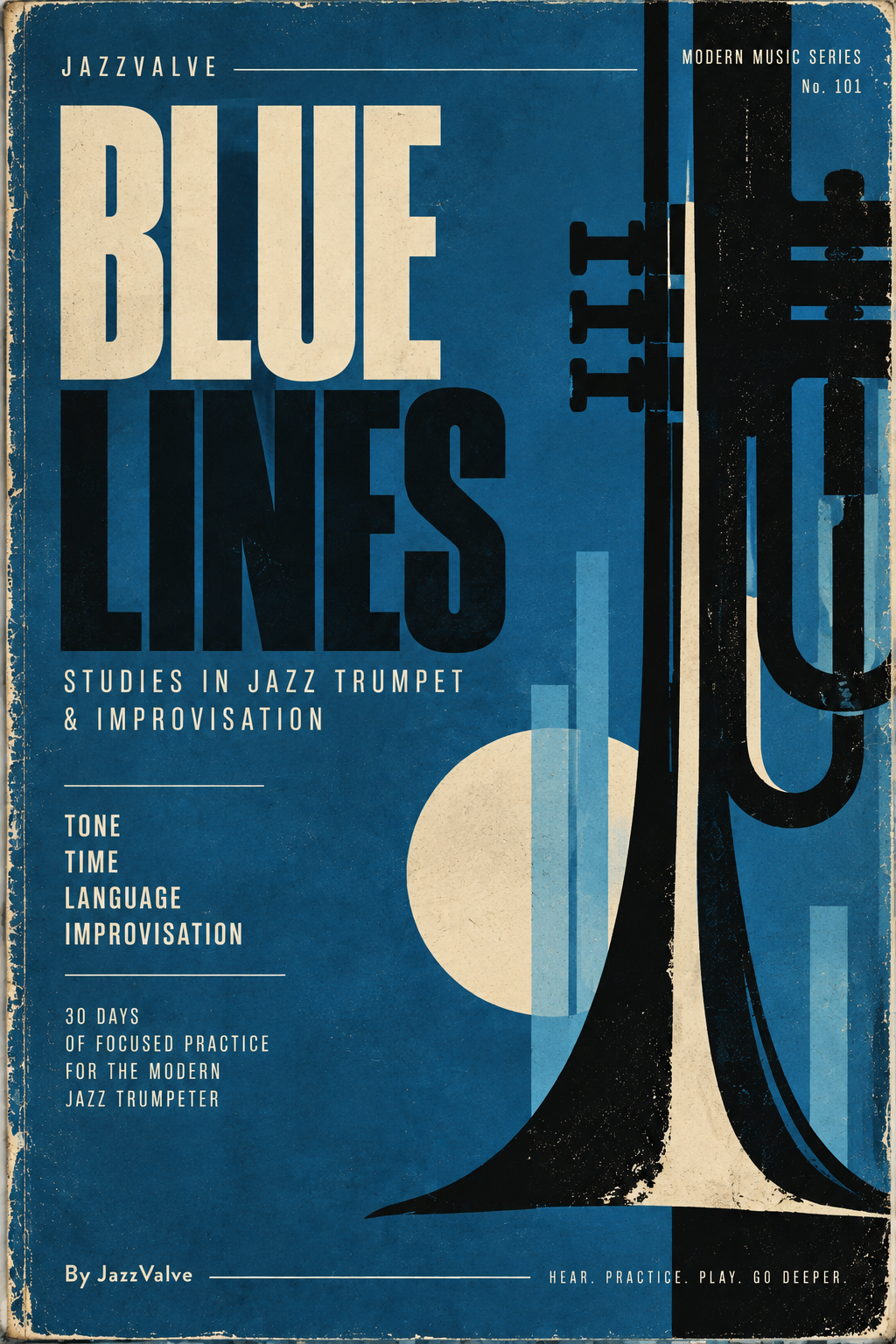
Free trumpet workbook
Blue Lines
Thirty days of focused B♭ trumpet practice: tone, time, jazz language and improvisation.
Sources
- Berklee: Why Lead Sheets? by Jonathan Feist — https://www.berklee.edu/berklee-today/summer-2018/lead-sheet
- UTEP: Instrument Transpositions for Musical Analysis by Charles Francis Leinberger — https://utminers.utep.edu/charlesl/transpose.html