Jazz Theory · October 20, 2026
By Justin Comstock · JazzValve creator, longtime guitarist and adult trumpet learner · Updated October 22, 2026
How to Improvise on Trumpet Over Chord Changes
Move from a planned eight-bar study to your own chord-tone choices, with written B-flat trumpet pitches, counted rests and clear harmonic targets.
Free trumpet workbook
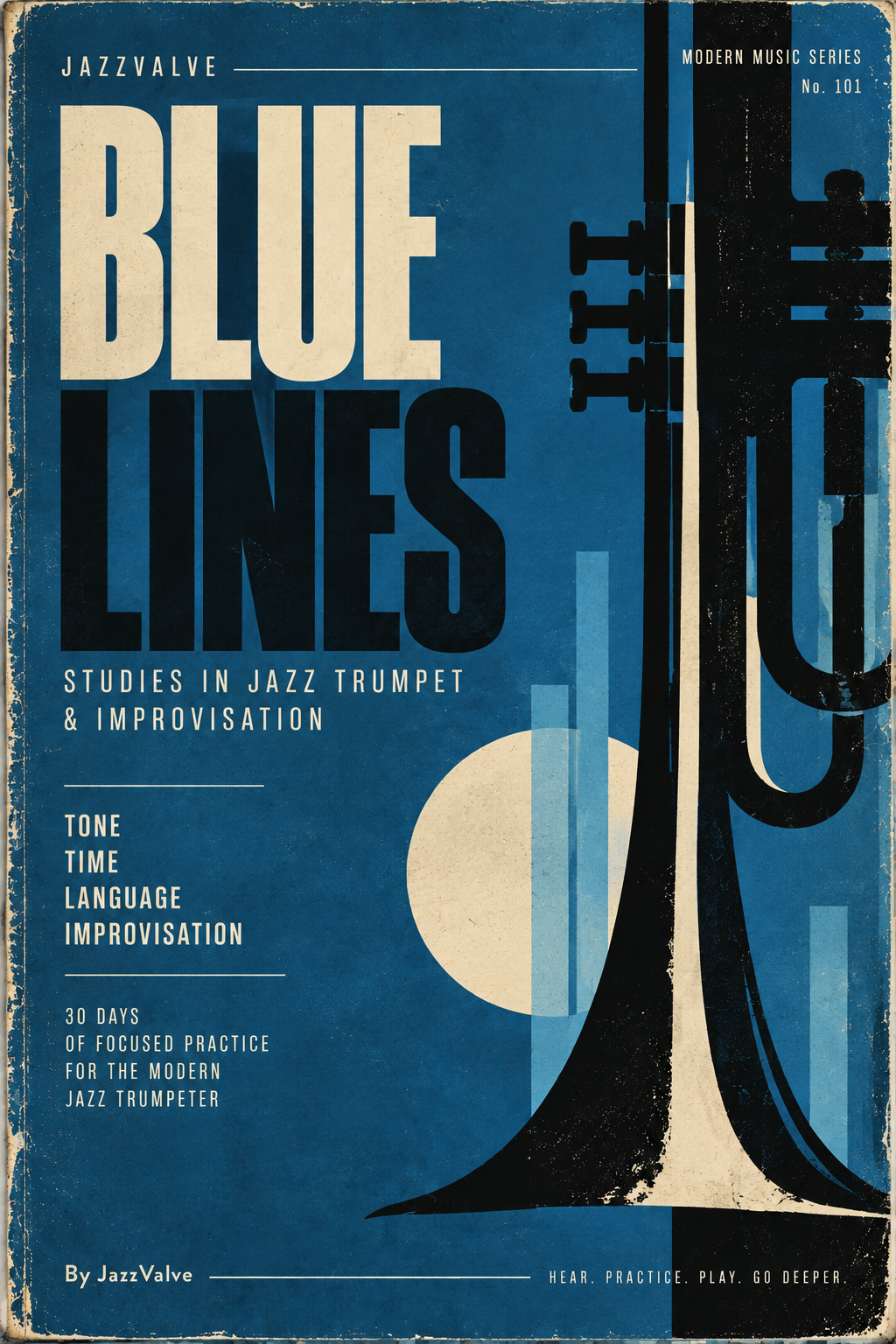
Blue Lines
Thirty days of focused B♭ trumpet practice: tone, time, jazz language and improvisation.
Email signup required
Get Blue Lines freeTo learn how to improvise on trumpet over changing chords, start by making a few choices you can hear: where the next chord begins, which note you want to reach, and how much space to leave. You do not need a different fast scale for every chord.
This lesson moves from a planned eight-bar study to your own decisions over the same harmony. It is for a player who can already produce comfortable notes from written E4 to C5 and count four beats per bar. If that is still new, begin with the first scale-phrase lesson.
Know which chords you are playing over
All exercise notes and the main chord symbols below are written for B-flat trumpet, not concert pitch. E4 is the first line of the treble staff, G4 the second line, B4 the middle line, and C5 the third space.
A standard B-flat trumpet sounds a major second below its written notes, as the UTEP instrument-transposition reference explains. Use the concert column when working with a pianist or a concert-pitch backing track. Do not transpose a trumpet part a second time.
Use this eight-bar practice loop in 4/4. Every chord lasts one full bar.
| Bar | Written trumpet chord | Concert accompaniment chord |
|---|---|---|
| 1 | Cmaj7 | B-flatmaj7 |
| 2 | Am7 | Gm7 |
| 3 | Dm7 | Cm7 |
| 4 | G7 | F7 |
| 5 | Cmaj7 | B-flatmaj7 |
| 6 | Am7 | Gm7 |
| 7 | Dm7 | Cm7 |
| 8 | G7 | F7 |
When the loop repeats, bar 8 leads back to bar 1. To finish instead, add one final bar of written Cmaj7, sounding concert B-flatmaj7.
Check the second chord carefully: Am7, not A7. Am7 contains C natural; A7 contains C-sharp and would change the available chord tones. This progression is a practice framework, not a transcription or a claim that every standard uses these changes.
Set a metronome to quarter note = 60, with one click on each beat. With accompaniment, first listen through the eight bars without playing. Say the bar numbers as you count.
JazzValve
Practice This In JazzValve
Open in the app →
Turn each chord symbol into a small note choice
A chord tone is a note belonging to the chord. Here are the four notes in each seventh chord and a smaller set for this lesson:
| Written chord | Chord tones | Comfortable choices in this study |
|---|---|---|
| Cmaj7 | C–E–G–B | E4, G4, B4, C5 |
| Am7 | A–C–E–G | E4, G4, A4, C5 |
| Dm7 | D–F–A–C | F4, A4, C5 |
| G7 | G–B–D–F | F4, G4, B4 |
The smaller sets omit some roots and fifths to keep the register compact. They are choices, not complete scales.
Berklee professor Hal Crook's discussion of chord-tone and chord-scale soloing recommends learning to shape melodies with chord tones before relying heavily on chord scales. The practical point here is simple: choose a few notes deliberately instead of running through every available pitch.
Put the trumpet down and name two choices for each bar. Then play one choice as a half note on beat 1 and rest on beats 3–4. Do not worry about making a polished solo yet. Listen to what happens when the accompaniment changes under a repeated note.
First pass: follow a planned eight-bar path
Read the note and rhythm transcript below. Staff notation requires JavaScript.
Notes, rhythm and playing instructions
- Bar 1: beat 1, chord Cmaj7, E4 quarter note, fingering 1+2, sounds D4; beat 2, G4 quarter note, fingering open, sounds F4; beat 3, B4 quarter note, fingering 2, sounds A4; beat 4, quarter rest.
- Bar 2: beat 1, chord Am7, C5 half note, fingering open, sounds B-flat4; beat 3, A4 quarter note, fingering 1+2, sounds G4; beat 4, quarter rest.
- Bar 3: beat 1, chord Dm7, A4 quarter note, fingering 1+2, sounds G4; beat 2, F4 quarter note, fingering 1, sounds E-flat4; beat 3, C5 quarter note, fingering open, sounds B-flat4; beat 4, quarter rest.
- Bar 4: beat 1, chord G7, B4 half note, fingering 2, sounds A4; beat 3, F4 quarter note, fingering 1, sounds E-flat4; beat 4, quarter rest.
- Bar 5: beat 1, chord Cmaj7, E4 half note, fingering 1+2, sounds D4; beat 3, G4 quarter note, fingering open, sounds F4; beat 4, quarter rest.
- Bar 6: beat 1, chord Am7, G4 quarter note, fingering open, sounds F4; beat 2, A4 quarter note, fingering 1+2, sounds G4; beat 3, C5 quarter note, fingering open, sounds B-flat4; beat 4, quarter rest.
- Bar 7: beat 1, chord Dm7, C5 half note, fingering open, sounds B-flat4; beat 3, A4 quarter note, fingering 1+2, sounds G4; beat 4, quarter rest.
- Bar 8: beat 1, chord G7, G4 quarter note, fingering open, sounds F4; beat 2, B4 quarter note, fingering 2, sounds A4; beat 3, F4 quarter note, fingering 1, sounds E-flat4; beat 4, quarter rest.
Map a complete eight-bar planned line to chord changes and breath spaces. Steady quarter-note pulse; no invented swing interpretation. Accompaniment reference. Bar 1: written Cmaj7 sounds concert Bbmaj7. Bar 2: written Am7 sounds concert Gm7. Bar 3: written Dm7 sounds concert Cm7. Bar 4: written G7 sounds concert F7. Bar 5: written Cmaj7 sounds concert Bbmaj7. Bar 6: written Am7 sounds concert Gm7. Bar 7: written Dm7 sounds concert Cm7. Bar 8: written G7 sounds concert F7. Concert pitches in the transcript are references only; play the written pitches on B-flat trumpet. No audio playback or fixed swing ratio is implied.
Play this original study. A half note lasts two beats; a quarter note or quarter rest lasts one beat. Every row totals four beats.
| Bar and chord | What to play |
|---|---|
| 1, Cmaj7 | E4 quarter note, G4 quarter note, B4 quarter note, quarter rest |
| 2, Am7 | C5 half note, A4 quarter note, quarter rest |
| 3, Dm7 | A4 quarter note, F4 quarter note, C5 quarter note, quarter rest |
| 4, G7 | B4 half note, F4 quarter note, quarter rest |
| 5, Cmaj7 | E4 half note, G4 quarter note, quarter rest |
| 6, Am7 | G4 quarter note, A4 quarter note, C5 quarter note, quarter rest |
| 7, Dm7 | C5 half note, A4 quarter note, quarter rest |
| 8, G7 | G4 quarter note, B4 quarter note, F4 quarter note, quarter rest |
Repeat at bar 1, or finish with E4 as a half note over the added Cmaj7 bar, then rest for two beats.
Listen especially to the F4 in bars 4 and 8 leading toward E4 on the following Cmaj7. The rest between them does not erase the connection. Hear E before you enter. The guide-tone lesson isolates that kind of harmonic movement if you need more time with it.
Learn two bars at a time, then rest for two bars. Join the full study only when the notes speak comfortably. This written example establishes a reference; copying it accurately is preparation for improvisation, not the final goal.
Second pass: make one decision before each bar
Keep the rhythm smaller now: a half note on beat 1, a quarter note on beat 3, and a quarter rest on beat 4.
For each chord, choose either of these pairs:
- Cmaj7: E4 then G4, or G4 then B4.
- Am7: G4 then A4, or C5 then A4.
- Dm7: F4 then A4, or A4 then C5.
- G7: B4 then F4, or G4 then B4.
Choose during the previous bar's rest rather than writing an eight-bar sequence in advance. You are now deciding what comes next while the music continues. Repeating a pair is allowed; variety is not a requirement on every bar.
On G7, try choosing B4 then F4, followed by E4 at the next Cmaj7. Compare that with G4 then B4 followed by E4. Both use chord tones, but the endings travel differently.
If you lose your place, stop playing and keep counting. Rejoin at the next bar 1. Do not race through missed notes to catch up.
JazzValve
Practice This In JazzValve
Open in the app →
Third pass: keep a destination, change the route
Choose E4 as the destination on beat 1 of bar 5. Leave that arrival fixed while changing bar 4. Try these two alternatives over written G7:
- Version A: B4 half note, F4 quarter note, quarter rest.
- Version B: Quarter rest, G4 quarter note, B4 quarter note, F4 quarter note.
Then play E4 as a half note at bar 5 and rest for beats 3–4. Version B leaves no rest before the arrival; Version A does. Count the destination in the same place in both versions.
Next invent a third bar-4 version using only F4, G4 and B4. Use quarter notes, half notes and rests; make the total exactly four beats. Sing or count the rhythm first, then play it.
This is a manageable way to bridge exercises and improvisation: keep one musical destination clear while changing a small part of the route. Later you can choose a different destination rather than treating E as a compulsory ending.
Add one passing note, not a whole new scale
Once the chord-tone choices feel reliable, try this bar over Cmaj7:
E4 quarter note, F4–G4 as two eighth notes on beat 2, B4 quarter note on beat 3, quarter rest on beat 4.
F is not a Cmaj7 chord tone. Here it passes between E and G rather than becoming a long stopping point. Compare the phrase with a version that holds F. Listen to the different tension instead of labeling every non-chord tone a mistake.
Learn the two eighth notes evenly first. If you add swing, keep the following quarter note on beat 3; do not let the shorter offbeat pull it early. Use the swing-eighth lesson for a separate timing study.
There is no need to add passing notes to all eight bars. Return to the chord-tone version whenever extra notes make you lose the form.
Check whether you are making musical choices
Record one eight-bar pass of the planned study and one of your chosen pairs. Listen with the horn down:
- Did each chord change happen at the expected bar?
- Did you count the rests without rushing?
- Can you identify one ending you chose intentionally?
- Can you sing that ending before playing it again?
For a real tune, learn its melody and form as well as its chord symbols. Berklee PULSE's improvisation preparation lesson includes mapping the key, melody, changes and form before chord-tone practice. A familiar written exercise is a bridge to that work, not a replacement for listening to the music.
Next, apply the same process to a short section of a tune you know: name the chords, select a small note set, plan one arrival, then vary the approach. The Blue Bossa chord-tone lesson offers a contrasting minor-key form when you are ready.
For a separate sequence of short daily studies, the free Blue Lines jazz trumpet workbook is available with email signup. Keep today's success measure small: one intentional phrase, in time, over chords you can follow.
JazzValve
Practice This In JazzValve
Open in the app →
Free trumpet workbook
Blue Lines
Thirty days of focused B♭ trumpet practice: tone, time, jazz language and improvisation.
Email signup required
Get Blue Lines freeSources
- Hal Crook, Berklee: Chord-Tone vs. Chord-Scale Soloing — https://college.berklee.edu/bt/121/chord.html
- Berklee PULSE: Lesson 4, Practicing Improvisation — https://pulse.berklee.edu/content/public/pub_unit_assets/Casio_Video_Series/video_4/lesson4_practicing_improv.pdf
- UTEP: Instrument Transpositions for Musical Analysis — https://utminers.utep.edu/charlesl/transpose.html