Technique · November 20, 2026
By Justin Comstock · JazzValve creator, longtime guitarist and adult trumpet learner · Updated November 20, 2026
How to Read Trumpet Sheet Music: Play Your First Four Bars
Learn three written notes, count four steady beats, and play a short original B-flat trumpet study.
Free trumpet workbook
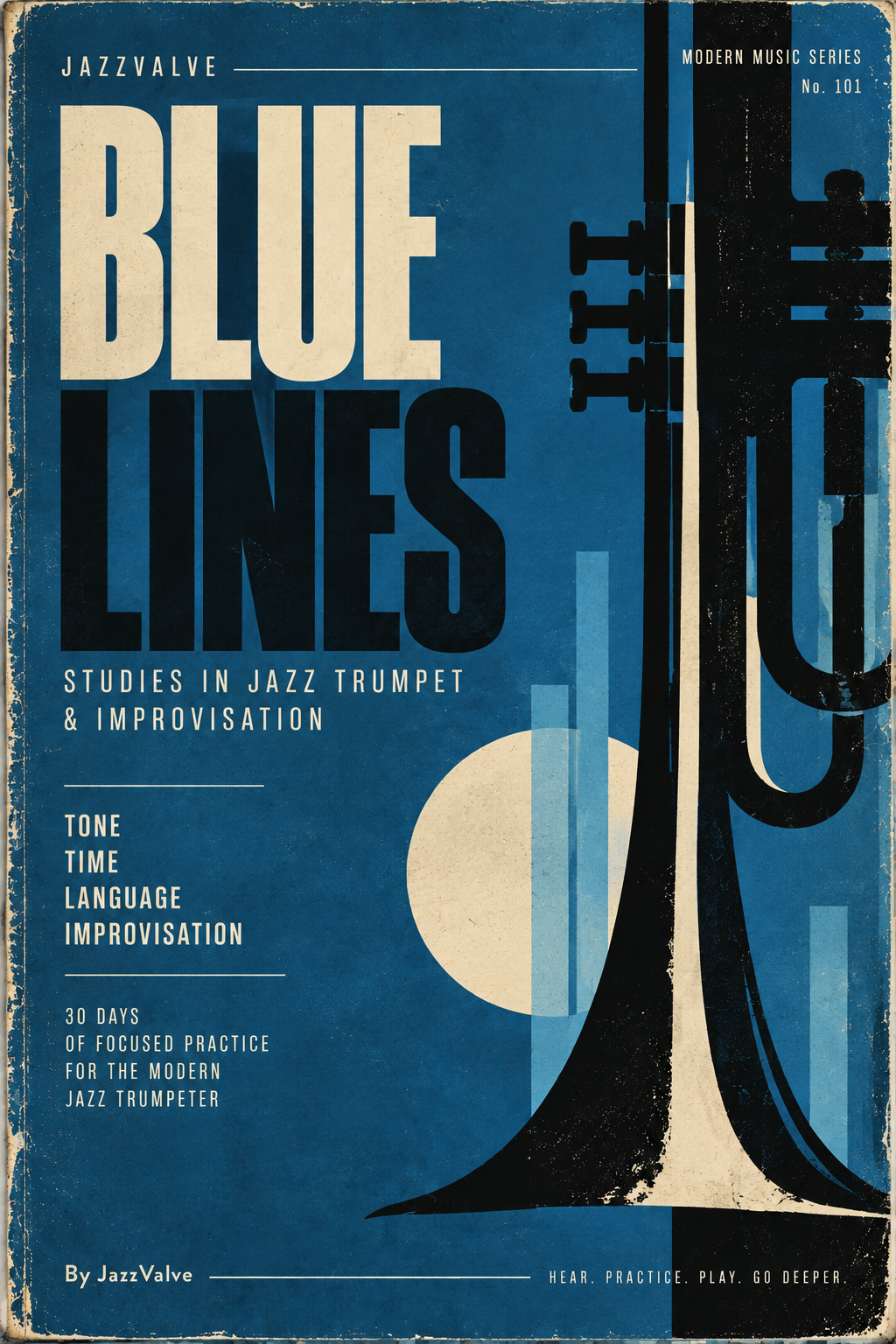
Blue Lines
Thirty days of focused B♭ trumpet practice: tone, time, jazz language and improvisation.
Email signup required
Get Blue Lines freeIf you can play a few trumpet notes but get lost looking at the staff, learn the rhythm and the notes separately. Start with three written notes on B-flat trumpet: C, D and E. Then put them together in four bars you can play today.
JazzValve
Practice This In JazzValve
Open in the app →
Where to find C, D and E
Most beginner trumpet parts use treble clef. At the bottom of the staff, the first line is E. The space just below that line is D. One small line below the staff, called a ledger line, is C. These are written pitches: they're the names printed in your trumpet part.
| Written note | Where it sits | Standard valves |
|---|---|---|
| Middle C (C4) | Ledger line just below the staff | Open (no valves) |
| D4 | Space just below the staff | 1 and 3 |
| E4 | Bottom line of the staff | 1 and 2 |
Valve 1 is closest to the mouthpiece; valve 3 is closest to the bell. Match the pitch with your ear as well as the valves. For example, both low C and G on the second line can be played open. If the first note is too high, compare it with a written-C reference played back at the correct pitch before going on. JazzValve’s fingering chart and Yamaha’s interactive fingering diagram show where to find more notes.
On a B-flat trumpet, written C sounds as concert B-flat. If you're playing from a trumpet part, read the written notes as shown. If a piano or a tuner in concert mode is your reference, look for B-flat when you play written C. See the written-to-concert pitch guide if you need to match a piano part.
Read the rhythm before touching the valves
This exercise is in 4/4, so count four quarter-note beats before the next bar. Each filled notehead with a stem and no flag is a quarter note here. Each open notehead with a stem is a half note. The small block sitting on a staff line in bar three is a half rest. It gets two beats of silence.
Keep saying “one, two, three, four” evenly, even on a held note or a rest. The beginning of each sound is a new entrance; the rest is time you can use to set up the next one.
JazzValve
Practice This In JazzValve
Open in the app →
Play “First Page,” an original four-bar study
Start around 60 bpm if that feels comfortable. One click is one beat. Count in for a full bar first.
Read the note and rhythm transcript below. Staff notation requires JavaScript.
Notes, rhythm and playing instructions
- Bar 1: beat 1, C4 quarter note, fingering open, sounds B-flat3; beat 2, D4 quarter note, fingering 1+3, sounds C4; beat 3, E4 half note, fingering 1+2, sounds D4.
- Bar 2: beat 1, D4 quarter note, fingering 1+3, sounds C4; beat 2, E4 quarter note, fingering 1+2, sounds D4; beat 3, D4 half note, fingering 1+3, sounds C4.
- Bar 3: beat 1, half rest; beat 3, C4 quarter note, fingering open, sounds B-flat3; beat 4, D4 quarter note, fingering 1+3, sounds C4.
- Bar 4: beat 1, E4 half note, fingering 1+2, sounds D4; beat 3, C4 half note, fingering open, sounds B-flat3.
Count in for one full bar. Clap the rhythm, finger it silently, then play at an easy volume.
| Bar | Beats 1–2 | Beats 3–4 |
|---|---|---|
| 1 | C4 on 1, D4 on 2 | E4 held over 3 and 4 |
| 2 | D4 on 1, E4 on 2 | D4 held over 3 and 4 |
| 3 | Rest on 1 and 2 | C4 on 3, D4 on 4 |
| 4 | E4 held over 1 and 2 | C4 held over 3 and 4 |
Pass one: clap it. Clap a single time on each entrance, but keep counting during the half notes. In bar three, the first clap is on beat 3.
Pass two: finger it. Say the note names at the same entrances and move the valves without playing. Pause between attempts, not inside the measure. If bar three feels difficult, repeat just the rest and two notes until the timing feels ordinary.
Pass three: play it. Play at an easy volume. Hold each half note until the following beat or bar begins. If you keep losing your place, play bars one and two alone, then bars three and four, before joining them.
What to read next
Try the same four bars tomorrow without looking at the table. When you can find the notes and keep a steady count, use the free Blue Lines workbook for short B-flat trumpet practice. It’s free with email signup. Once you can read a phrase slowly, the JazzValve sight-reading guide will help you preview a new chart and keep your place on the first pass.
JazzValve
Practice This In JazzValve
Open in the app →
Free trumpet workbook
Blue Lines
Thirty days of focused B♭ trumpet practice: tone, time, jazz language and improvisation.
Email signup required
Get Blue Lines freeSources
- https://www.yamaha.com/en/musical_instrument_guide/trumpet/play/play002.html