Technique · October 20, 2026
By Justin Comstock · JazzValve creator, longtime guitarist and adult trumpet learner · Updated October 21, 2026
Jazz Trumpet Etudes: An Original 16-Bar Phrasing Study
Practice a complete original sixteen-bar jazz trumpet etude with counted rhythms, deliberate releases and a four-section rehearsal plan.

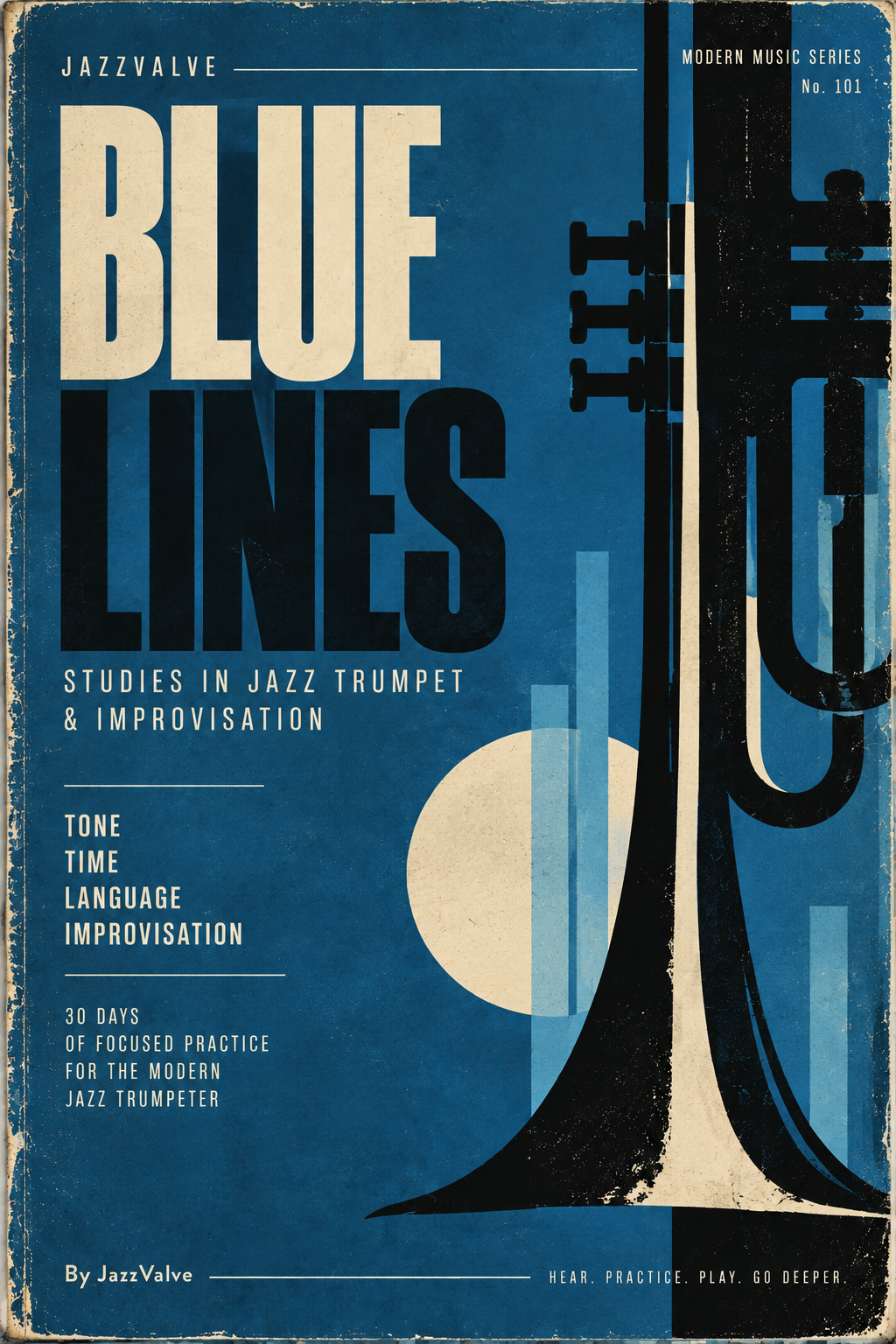
Free trumpet workbook
Blue Lines
Thirty days of focused B♭ trumpet practice: tone, time, jazz language and improvisation.
Email signup required
Get Blue Lines freeJazz trumpet etudes let you work on several musical decisions inside a finished piece: where a phrase starts, which notes connect, how a line changes character, and where it ends. The original sixteen-bar study below gives those decisions a clear shape without asking you to improvise while you read.
You can learn it in four short sections, then play the whole piece as a performance. It suits a player who is comfortable from written D4 to B4 and can count quarter notes, half notes and pairs of eighth notes. No high notes, backing track or transcription is required.
What this study asks you to hear
This etude has four four-bar sections. The opening leaves room between statements. The second section becomes more connected. The third begins its phrases later. The last brings back the opening rhythm with a different ending.
Keep that shape in mind before working on speed. A correct string of notes can still hide the relationship between the sections. Your first goal is to make those differences audible at a comfortable tempo.
Trumpeter Jeff Conner's practice advice for Yamaha recommends slow, goal-directed work in small segments. The etude and practice sequence here are original applications of that approach, not a Conner composition or prescribed routine.
JazzValve
Practice This In JazzValve
Open in the app →
Set up the pitches and rhythm
All notes and chord symbols in the study are written for standard B-flat trumpet. Written D4 sits just below the treble staff, F4 in the first space, A4 in the second space, and B4 on the middle line. The sounding range is concert C4 to A4.
A B-flat trumpet sounds a major second below its written pitch, as shown in UTEP's transposition reference. If someone accompanies you, give them the concert chords rather than the written trumpet labels.
Use 4/4 at quarter note = 60–72, with one click per beat. Begin with even eighth notes to check the count. Once secure, use a relaxed swing feel consistently throughout. The swing-eighth lesson can help you separate the beat from the placement of the offbeat.
The chord plan is a deliberately simple sixteen-bar study, not a twelve-bar blues:
| Bars | Written trumpet harmony | Concert accompaniment |
|---|---|---|
| 1–4 | Dm7 | Cm7 |
| 5–8 | G7 | F7 |
| 9–12 | Dm7 | Cm7 |
| 13–14 | G7 | F7 |
| 15–16 | Cmaj7 | B-flatmaj7 |
Each chord lasts for every bar in its indicated group. Accompaniment is optional; the melody can be learned with only a metronome.
Play the complete sixteen-bar etude
In this table, q means a quarter note, h a half note, e an eighth note, and rest a quarter rest unless a longer duration is given. Read each row from left to right. Every row totals four beats.
Lightly tongue each note unless a slur is specified below the table. Leave the written rests empty.
| Bar | Notes and rests, in order |
|---|---|
| 1 | D4 q, F4 e, A4 e, A4 q, rest |
| 2 | F4 h, E4 q, rest |
| 3 | D4 q, F4 e, A4 e, F4 q, rest |
| 4 | D4 h, half rest |
| 5 | G4 q, A4 e, B4 e, A4 q, G4 q |
| 6 | F4 h, D4 q, rest |
| 7 | B4 q, A4 e, G4 e, F4 q, D4 q |
| 8 | F4 h, half rest |
| 9 | Rest, D4 q, F4 q, A4 q |
| 10 | Rest, A4 q, G4 q, F4 q |
| 11 | Rest, F4 e, E4 e, D4 h |
| 12 | F4 q, D4 q, half rest |
| 13 | G4 q, A4 e, B4 e, F4 q, rest |
| 14 | D4 h, F4 q, rest |
| 15 | E4 q, G4 e, B4 e, G4 q, rest |
| 16 | E4 h, half rest |
For clarity, bar 1 is D4 on beat 1; F4–A4 on beat 2 and its offbeat; A4 on beat 3; rest on beat 4. The repeated A is intentional. In bar 11, the opening rest occupies beat 1, F–E fills beat 2, and D lasts through beats 3–4.
Use these connection instructions on the finished pass:
- Bars 1–4: tongue every attack lightly. Give each final note its full written duration.
- Bars 5 and 7: slur only the two eighth notes to one another. Tongue the notes before and after that pair.
- Bars 9–12: keep the delayed entrances calm. In bar 11, slur F4 to E4, then tongue the D4 on beat 3.
- Bars 13–16: return to lightly tongued notes. Let the final E4 last exactly two beats, then release on beat 3.
These markings define this study's phrasing. They are not a rule that every jazz line needs the same articulation.
JazzValve
Practice This In JazzValve
Open in the app →
Learn the difficult joins first
Practice bars 5–6 slowly. The A in bar 5 passes between G and B; it is not a G7 chord tone. Keep it moving to B, then hear how the line falls toward F in the next bar. You do not need to label every note while playing, but knowing the destination can make the shape easier to remember.
Next join bars 14–16. Written F4 moves to E4 at bar 15, connecting the seventh of G7 to the third of Cmaj7. The guide-tone lesson explores that resolution separately. Here it serves the ending of a complete piece.
Finally, practice bars 8–9 without breaking the count. The half rest at the end of bar 8 and the opening rest in bar 9 create three consecutive silent beats across the bar line. Count them; do not shorten the space because the horn is down.
Build one reliable performance
Work on four bars, then rest for at least the same amount of time. When each section is comfortable, connect sections in pairs before attempting all sixteen bars. Take a comfortable breath during the written rests as needed; pause the exercise if a section feels strained.
For one pass, focus only on beginnings and releases. For another, listen for the slurred eighth-note pairs. Avoid changing tempo, articulation and dynamics all at once. The articulation exercises provide simpler comparisons if a connection keeps breaking down.
Record a complete pass without stopping to fix slips. Listen back with the table in front of you. Can you hear the four sections? Is bar 9 still in time after the silence? Does the last E finish at the planned point?
Mark one bar to revisit, then play the ending once more. A useful etude session leaves you with a specific musical improvement to hear tomorrow, rather than only a faster metronome setting.
For additional short daily material, the free Blue Lines workbook is available with email signup.
JazzValve
Practice This In JazzValve
Open in the app →
Free trumpet workbook
Blue Lines
Thirty days of focused B♭ trumpet practice: tone, time, jazz language and improvisation.
Email signup required
Get Blue Lines freeSources
- UTEP: Instrument Transpositions for Musical Analysis — https://utminers.utep.edu/charlesl/transpose.html
- Jeff Conner, Yamaha: Fix It: Trumpet Teaching Tips — https://hub.yamaha.com/music-educators/instruments/winds-instruments/trumpet-pedagogy/