Technique · October 21, 2026
By Justin Comstock · JazzValve creator, longtime guitarist and adult trumpet learner · Updated October 22, 2026
Jazz Waltz on Trumpet: Count and Phrase in 3/4
Learn to keep three beats moving with an original eight-bar trumpet waltz, clear rest counts, and a simple swing variation.

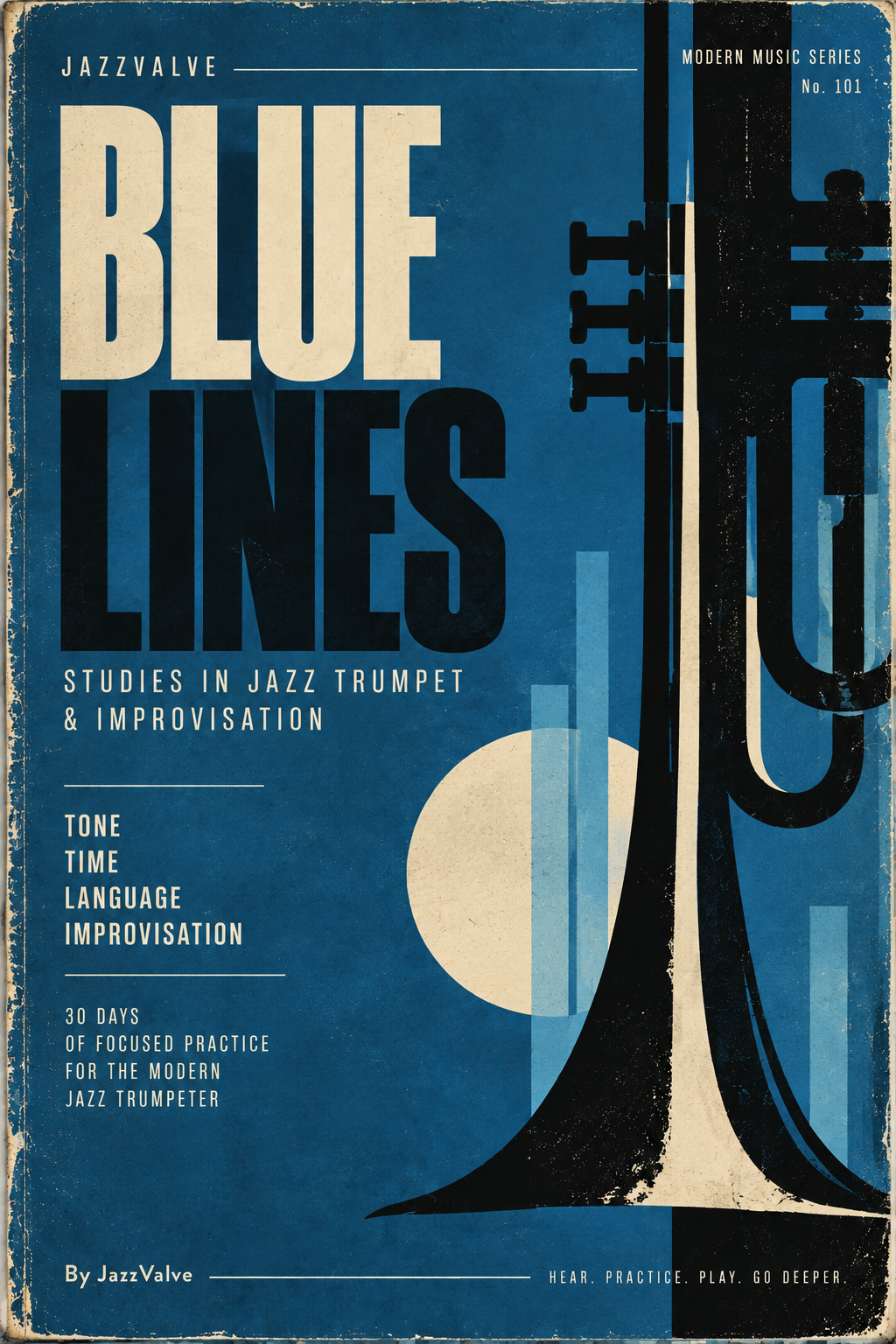
Free trumpet workbook
Blue Lines
Thirty days of focused B♭ trumpet practice: tone, time, jazz language and improvisation.
Email signup required
Get Blue Lines freeA jazz waltz asks you to keep three beats moving while your phrases cross, delay, or briefly hide the bar line. If most of your trumpet practice is in 4/4, the first useful change is small: count “1, 2, 3,” and return directly to 1. Do not add a fourth beat while you breathe.
This lesson builds that habit with an original eight-bar study. You can learn it with a metronome before adding a backing track or working on a standard.
Hear three beats before adding swing
JB Dyas's Jazz Fundamentals glossary describes the jazz waltz as a swing groove with a three-beat feel. The exercises here are specifically in 3/4, with three quarter-note beats per bar.
Set your metronome to quarter note = 90, clicking on every beat. If it has a meter setting, choose three beats with an accent on the first. Count four bars aloud:
1, 2, 3 | 1, 2, 3 | 1, 2, 3 | 1, 2, 3
Tap every numbered beat. The accent helps locate the bar; it does not ask you to blast every beat 1 on the trumpet. Try saying the first number slightly more clearly without slowing the other two.
A bar of 3/4 can contain six eighth notes, grouped as three pairs. That is different from the usual two-beat grouping of 6/8. For this lesson, keep hearing three main pulses, even when smaller notes appear.
JazzValve
Practice This In JazzValve
Open in the app →
Set up a comfortable written key
All pitches below are written for B-flat trumpet. The study stays between C4, the ledger-line C below the treble staff, and A4, the second-space A. That range sounds concert B-flat3 to G4.
A standard B-flat trumpet sounds a major second below its written notes, as shown in UTEP's instrument transposition reference. The study uses notes from written F major. For optional accompaniment, use a single concert E-flat major chord, equivalent to written F major, rather than a concert F chord.
Start unaccompanied if the key distinction is distracting. The first job is maintaining three beats, not following chord changes.
Exercise 1: Keep the silent beat in place
Use written F4 throughout this two-bar pattern:
- Bar 1: F4 quarter note on beat 1; quarter rest on beat 2; F4 quarter note on beat 3.
- Bar 2: F4 half note beginning on beat 1; quarter rest on beat 3.
Every bar totals three beats. In bar 1, release the first note at beat 2. In bar 2, hold the half note through beats 1 and 2, releasing precisely as beat 3 begins.
Play the pair twice, then count two complete bars without playing. That gives you four played bars followed by six silent quarter-note beats. Breathe in the rests without stopping the count.
If the second bar feels unfinished, you may still be expecting beat 4. Speak “one-two-three-one” over the bar line before playing again. Keep the transition from 3 to 1 the same length as the transition from 1 to 2.
JazzValve
Practice This In JazzValve
Open in the app →
Exercise 2: Play an eight-bar jazz waltz study
Read the note and rhythm transcript below. Staff notation requires JavaScript.
Notes, rhythm and playing instructions
- Bar 1: beat 1, F4 quarter note, fingering 1, sounds E-flat4, light tongue; beat 2, A4 quarter note, fingering 1+2, sounds G4, light tongue; beat 3, G4 quarter note, fingering open, sounds F4, light tongue.
- Bar 2: beat 1, E4 half note, fingering 1+2, sounds D4, light tongue; beat 3, C4 quarter note, fingering open, sounds B-flat3, light tongue.
- Bar 3: beat 1, D4 quarter note, fingering 1+3, sounds C4, light tongue; beat 2, E4 quarter note, fingering 1+2, sounds D4, light tongue; beat 3, F4 quarter note, fingering 1, sounds E-flat4, light tongue.
- Bar 4: beat 1, F4 dotted half note, fingering 1, sounds E-flat4, light tongue.
- Bar 5: beat 1, quarter rest; beat 2, A4 quarter note, fingering 1+2, sounds G4, light tongue; beat 3, G4 quarter note, fingering open, sounds F4, light tongue.
- Bar 6: beat 1, E4 half note, fingering 1+2, sounds D4, light tongue; beat 3, quarter rest.
- Bar 7: beat 1, D4 quarter note, fingering 1+3, sounds C4, light tongue; beat 2, E4 quarter note, fingering 1+2, sounds D4, light tongue; beat 3, G4 quarter note, fingering open, sounds F4, light tongue.
- Bar 8: beat 1, F4 half note, fingering 1, sounds E-flat4, light tongue; beat 3, quarter rest.
Read three-beat bars and distinguish a full dotted-half ending from a half-note ending with a silent third beat. Three-beat jazz-waltz pulse; this original version contains no eighth notes to swing. Do not silently substitute the later bar-5 variation. Optional accompaniment only: written F sounds concert Eb; single major chord throughout, as specified in setup section. Concert pitches in the transcript are references only; play the written pitches on B-flat trumpet. No audio playback or fixed swing ratio is implied.
Learn this original melody with quarter notes and half notes first. A dotted half note lasts three beats, filling one entire bar of 3/4. Every other duration is stated below.
- F4 quarter on 1; A4 quarter on 2; G4 quarter on 3.
- E4 half note on 1–2; C4 quarter on 3.
- D4 quarter on 1; E4 quarter on 2; F4 quarter on 3.
- F4 dotted half note across 1–2–3.
- Quarter rest on 1; A4 quarter on 2; G4 quarter on 3.
- E4 half note on 1–2; quarter rest on 3.
- D4 quarter on 1; E4 quarter on 2; G4 quarter on 3.
- F4 half note on 1–2; quarter rest on 3.
Lightly tongue each new note. Hold the specified lengths rather than inserting a gap at every click. Take a comfortable breath during the opening rest in bar 5 and the rests in bars 6 and 8. If four bars on one breath is too much, practice two-bar sections with a pause between them instead of forcing the phrase.
Notice the different endings. Bar 4 fills the measure; bar 8 leaves its final beat silent. Neither ending has a fourth beat. Record both and check whether the next count starts at the same point.
Add eighth notes without changing the meter
Once the study is secure, replace only bar 5 with this variation:
- Beat 1: quarter rest.
- Beat 2: A4 then G4, two eighth notes.
- Beat 3: E4 quarter note.
First play the eighths evenly, counting “1-and, 2-and, 3-and.” Then give the pair on beat 2 a familiar swing feel. Both eighths still fit inside that single beat; E4 still arrives on beat 3.
The swing eighth-note lesson provides a separate starting exercise if that placement is unfamiliar. Avoid treating a triplet approximation as an exact rule: Open Music Theory explains that swing ratios vary with the performance.
Keep the rest of the study unchanged so you can hear what the new rhythm contributes. Adding notes everywhere makes it harder to diagnose a lost beat.
Test the bar rather than the speed
For an optional next step, keep the musical tempo at quarter note = 90 but use one plain click per bar at 30 clicks per minute, hearing every click as beat 1. Count beats 2 and 3 evenly between clicks. Only try this after three clicks per bar feels dependable.
Do not combine that slower click setting with another setting that removes beats. If the bars drift, restore 90 clicks per minute and the three-beat count.
Finish by playing the study once without stopping. Listen for the entrance after bar 4, the silence in bar 6, and the final release on beat 3. Then change one phrase of your own while keeping all eight three-beat bars intact. The motif-development lesson offers ideas for changing a phrase; adapt its concepts, not its four-beat bar lengths.
For another short practice resource, the free Blue Lines workbook is available with email signup.
JazzValve
Practice This In JazzValve
Open in the app →
Free trumpet workbook
Blue Lines
Thirty days of focused B♭ trumpet practice: tone, time, jazz language and improvisation.
Email signup required
Get Blue Lines freeSources
- JB Dyas, Jazz Fundamentals, glossary p. 22 — https://jazzday.com/media/Monk-Institute-Handout-Packet-JB-Dyas-Video-1.pdf#page=22
- Charles Leinberger, UTEP: Instrument Transpositions for Musical Analysis — https://utminers.utep.edu/charlesl/transpose.html
- Open Music Theory: Swing Rhythms — https://viva.pressbooks.pub/openmusictheory/chapter/swing-rhythms/