Technique · October 16, 2026
By Justin Comstock · JazzValve creator, longtime guitarist and adult trumpet learner · Updated October 16, 2026
Learn Jazz Trumpet by Ear: Your First Short Phrase
Learn a short jazz trumpet phrase through listening, singing, pitch matching, and focused playback checks before you write down a single note.
You can begin to learn jazz trumpet by ear with a few seconds of music. Choose one short phrase, get familiar with its sound, and work toward playing it from memory. Leave notation until later in this exercise.
The aim for your first session is specific: hear the phrase clearly enough to notice where your version differs. You do not need to finish a whole solo or identify every chord.
Choose a phrase you can investigate
Find a recording where the trumpet is easy to hear. Start with roughly three to six notes in a comfortable playing range, ideally followed by a little space. A short melody fragment works just as well as part of an improvised solo.
Save the recording title, performer, and start time. Set your loop to include a little music before the phrase so you can hear its entrance. Avoid a loop that clips the first attack or cuts off the last note.
Listen once to the surrounding passage, then narrow your attention to the selected phrase.
JazzValve
Practice This In JazzValve
Open in the app →
Hear it, then answer it
Put the trumpet down. Play the phrase, pause, and sing or hum it back in a comfortable vocal register. Listen again before each attempt.
Berklee’s performance ear-training curriculum uses call-and-response activities that connect listening, singing, and instrumental playing. That sequence provides a useful starting point for this exercise. Berklee: Ear Training for Live Performance
Ask yourself three questions:
- Where does the phrase begin relative to the beat?
- Does the melody move upward, downward, or repeat a pitch?
- Which note feels like the destination?
If the answer keeps changing, shorten the excerpt. You might begin with only the first two notes. Aim for a recognizable version rather than a polished singing voice.
Find the first note deliberately
Replay the opening note, hum it, and try matching it on your trumpet. After each attempt, ask whether your sound was higher, lower, or approximately the same. Move toward the target rather than running through unrelated notes.
Once you have a match, stop and listen again. Then connect the second note to the first. Keep returning to the recording so your most recent attempt does not become your reference.
If you use a keyboard or tuner, remember that a B-flat trumpet’s written C sounds concert B-flat. Label any note names you save as either written B-flat trumpet pitch or concert pitch. Matching the sound itself does not require converting note names. See the B-flat trumpet transposition guide if you need to label pitches from a concert-pitch source.
JazzValve
Practice This In JazzValve
Open in the app →
Compare one detail at a time
Build the phrase in small sections, then join them. You can slow the recording if necessary, using playback that preserves pitch. Return to the original speed regularly to hear the phrase in context.
Jazz St. Louis’s JazzU handbook recommends learning recorded music through listening, singing, and playing before writing it down. It also encourages comparing your playing with the recording, including through self-recording. JazzU Student Handbook, section 2.3
Make one brief recording of your attempt. Listen for a single feature on each comparison:
- Pitch: Is one note consistently above or below the target?
- Timing: Does your entrance arrive at the same point?
- Length: Are you holding a note after the original has ended?
- Articulation: Is an attack more pronounced than the one you hear?
Choose one difference to address. Replaying the whole phrase without a question gives you less useful information about the next adjustment.
Use the problem to choose your next step
If you can sing the phrase but cannot play it, keep the excerpt small and work on the connection between the sung sound and the instrument.
If you can play along but lose the phrase when playback stops, try alternating one recorded example with one unaccompanied response.
If the pitches seem right but the phrase remains unfamiliar, tap its rhythm without playing. Then return to the trumpet and check the spaces between notes.
If you cannot tell what is wrong, ask a teacher or experienced player to compare the same short excerpt with your attempt. Give them a precise question, such as whether your second note matches.
Check it tomorrow
Before replaying the source the next day, try singing and playing the phrase from memory. Then check it against the recording. Treat any missing detail as the next practice target.
Once the phrase feels secure, write it down if that supports your learning. Include the source and timestamp so you can revisit the sound behind the notation.
Finish with one clear observation: perhaps the final note is shorter than you expected, or the entrance begins earlier. That gives your next session a useful starting point.
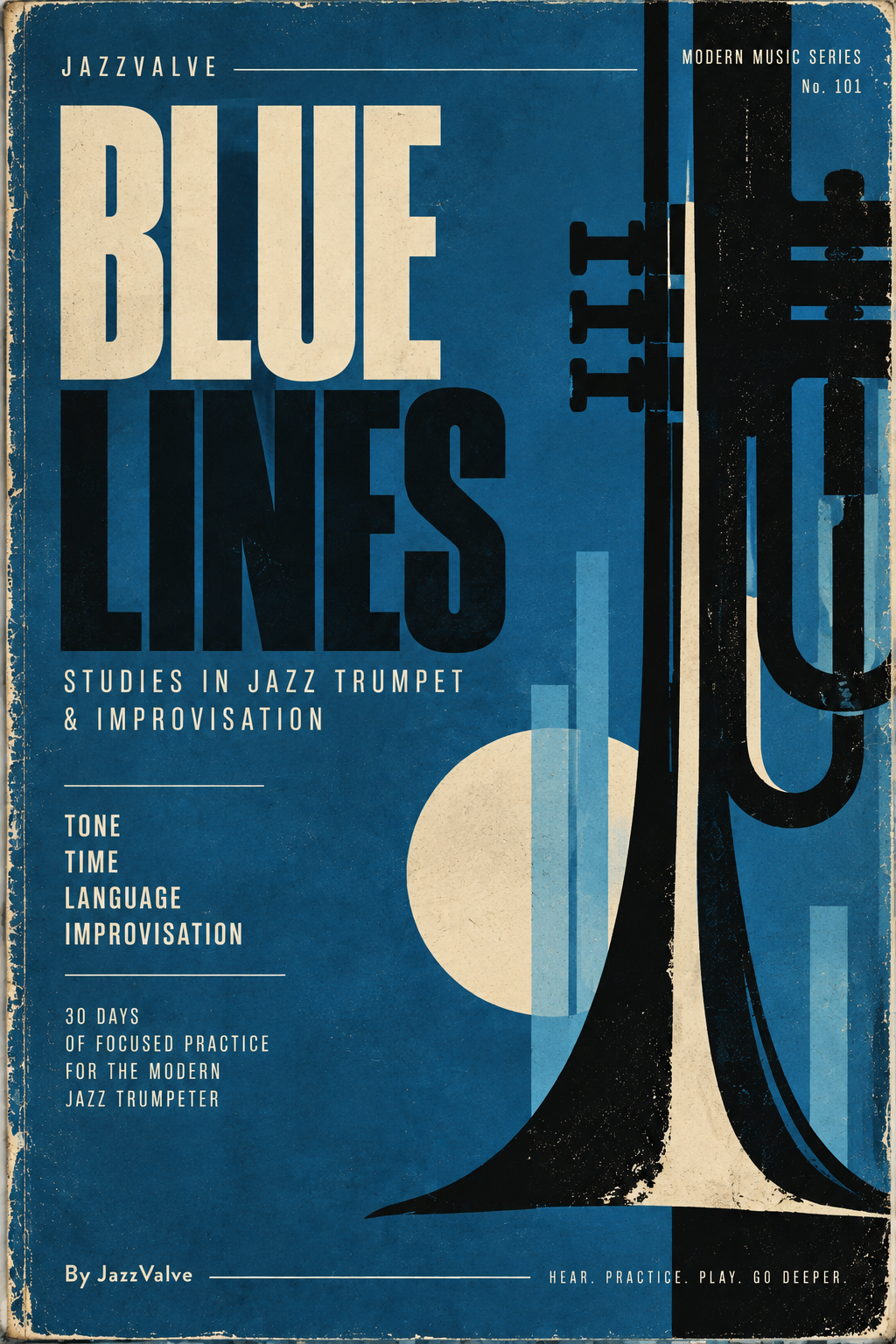
For a separate practice resource, get the free Blue Lines jazz trumpet workbook with email signup.
JazzValve
Practice This In JazzValve
Open in the app →
Free trumpet workbook
Blue Lines
Thirty days of focused B♭ trumpet practice: tone, time, jazz language and improvisation.
Sources
- Berklee Online: Ear Training for Live Performance — https://online.berklee.edu/courses/ear-training-for-live-performance
- Jazz St. Louis: 2022–23 JazzU Student Handbook, section 2.3 and transposition chart — https://jazzstl.org/wp-content/uploads/2022/08/22-23-JazzU-Student-Handbook.pdf