Technique · October 18, 2026
By Justin Comstock · JazzValve creator, longtime guitarist and adult trumpet learner · Updated October 18, 2026
Metronome on 2 and 4: A Jazz Trumpet Practice Guide
Set the metronome to half the quarter-note tempo, hear clicks on 2 and 4, and practise two counted trumpet studies without losing the beat.
A metronome on beats 2 and 4 gives you two clicks in a four-beat bar. Your job is to keep the other two beats in place. Start with counting and one comfortable trumpet note so you can hear exactly where the pulse slips.
This lesson uses 4/4 time and written pitches for B-flat trumpet. Written G4 is the G on the second line of the treble staff; it sounds concert F4. Written C4 is middle C, one ledger line below the staff; it sounds concert B-flat3. Both use open valves. Choose whichever note feels comfortable today.
Set the click rate without changing the music's tempo
Suppose the music's tempo is quarter note = 80. With a click on every beat, set the metronome to 80 clicks per minute. For clicks only on beats 2 and 4, set it to 40 clicks per minute. You still count four quarter-note beats per bar at the original speed.
| Music's quarter-note tempo | Metronome clicks per minute for 2 and 4 |
|---|---|
| 80 | 40 |
| 100 | 50 |
| 120 | 60 |
Use a plain, evenly spaced click with no subdivisions or recurring accent pattern. If your metronome has a dedicated setting that silences beats 1 and 3, you can instead leave its quarter-note tempo at 80 and use that setting. Do not halve the tempo and also silence half the beats.
This exercise is one way to practise time. It does not make every phrase swing automatically. Berklee's discussion of rushing and time feel presents several metronome approaches, including 2 and 4, rather than a single rule for everyone.
JazzValve
Practice This In JazzValve
Open in the app →
Count in before lifting the trumpet
First set the click to 80 and count “1, 2, 3, 4” with one number per click. Keep that walking-speed pulse in mind.
Now set the plain click to 40. Hear one click as 4. Halfway to the next click, say 1. Say 2 with the next click, 3 halfway to the following click, and 4 with that click.
The repeating pattern is:
1 — 2 (click) — 3 — 4 (click)
The four numbers are evenly spaced. Each click-to-click interval contains two quarter-note beats. Count four complete bars before playing.
If the clicks start feeling like 1 and 3, stop and count in again. Jazzadvice's metronome lesson also separates learning to hear the beat placement from playing over it. Give the counting stage its own attention.
Exercise 1: Play where there is no click
Keep the metronome at 40 clicks per minute, with the music at quarter note = 80. Use written G4 or C4 throughout this original two-bar study.
| Bar | Beat 1 | Beat 2, click | Beat 3 | Beat 4, click |
|---|---|---|---|---|
| 1 | Quarter note | Quarter rest | Quarter note | Quarter rest |
| 2 | Quarter rest | Quarter rest | Quarter rest | Quarter rest |
Each note lasts one beat. Release it as the following click arrives. Bar 2 is a full bar of silence: count all four beats, breathe comfortably, and prepare the next entrance.
Repeat four times. The test is whether your notes on 1 and 3 sit halfway between clicks. Avoid waiting for a click and reacting to it; the note should already have its place in your count.
If you keep arriving late, put the trumpet down and speak the rhythm. Then return to the instrument. If the sound becomes strained, take a break.
JazzValve
Practice This In JazzValve
Open in the app →
Exercise 2: Hold through the click
Use the same note and tempo. This four-bar study changes the relationship between the note attacks and the metronome.
- Bar 1: Play a half note on beat 1, holding through beat 2. Play another half note on beat 3, holding through beat 4.
- Bar 2: Rest for all four beats.
- Bar 3: Rest on beat 1. Play a quarter note on beat 2. Rest on beat 3. Play a quarter note on beat 4.
- Bar 4: Rest for all four beats.
In bar 1, both clicks happen inside sustained notes. In bar 3, both clicks coincide with new attacks. Keep the tempo identical in both bars. Let the metronome continue during the rests.
Record two cycles. Listen separately for the entrances in bar 1 and bar 3. If one type is less secure, repeat that bar followed by a full bar of rest.
Diagnose the common mix-ups
The tempo changes when you halve the click rate. Return to 80 with four clicks per bar and count “1, 2, 3, 4.” Then set the clicks to 40 while keeping your four-count at that same speed. Each click-to-click interval now spans two quarter-note beats.
The clicks sound like 1 and 3. Recount aloud with 2 and 4 on the clicks. Record that count-in immediately before a played pass so you can check whether your beat labels change at the entrance.
The rest bar gets shorter. Keep the same four-count during silence. You should hear two clicks in each rest bar, just as in each played bar.
The note starts correctly but ends early. Count the full written duration. In exercise 2, a half note lasts two quarter-note beats even though only one click occurs during it.
Take the pulse back to a phrase
Choose a two-bar phrase you already know. Play it first with a click on every quarter note. Then halve the click rate and hear 2 and 4 while preserving the phrase's tempo and rhythm.
If swung eighths are part of the phrase, review the swing eighth-note lesson. This metronome exercise concerns beat placement; the spacing of the eighth notes is another detail to listen for.
Once a short phrase is secure, use the 12-bar blues form lesson to practise keeping the same pulse through a complete chorus. Check the written and concert keys there before adding accompaniment.
For another short practice resource, Blue Lines is a free jazz trumpet workbook available with email signup.
Finish by writing down the music's tempo and the click setting separately: “quarter note = 80; clicks = 40, on 2 and 4.” That small distinction makes tomorrow's starting point clear.
JazzValve
Practice This In JazzValve
Open in the app →
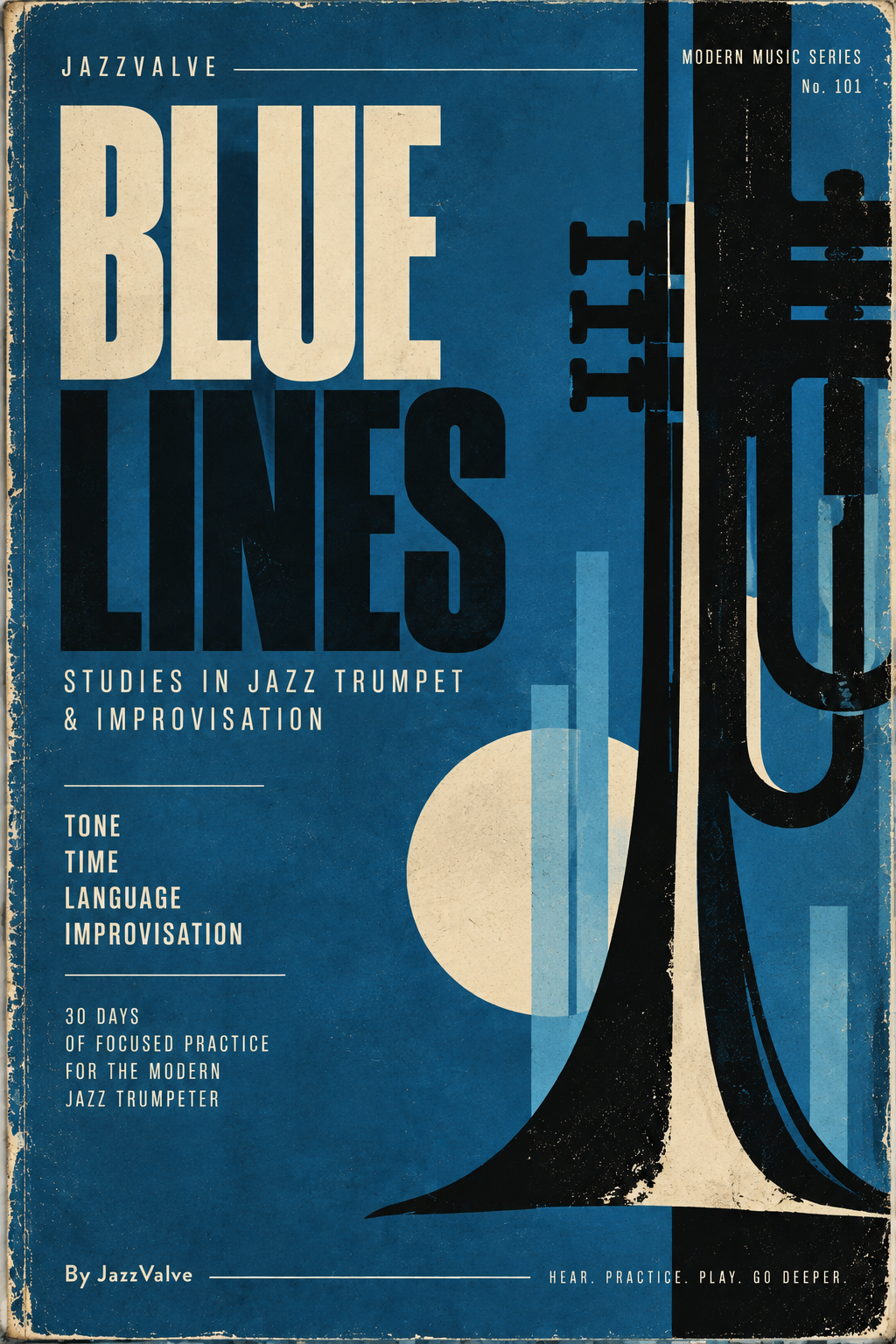
Free trumpet workbook
Blue Lines
Thirty days of focused B♭ trumpet practice: tone, time, jazz language and improvisation.
Sources
- Berklee: Confessions of a Serial Rusher — https://www.berklee.edu/berklee-today/summer-2005/cofessions-of-a-serial-rusher
- Jazzadvice: Develop a Stronger Sense of Time: Using a Metronome on 2 & 4 — https://www.jazzadvice.com/lessons/develop-a-stronger-sense-of-time-using-a-metronome-on-2-4/
- UTEP: Instrument Transpositions for Musical Analysis — https://utminers.utep.edu/charlesl/transpose.html
- Yamaha: Trumpet fingering chart — https://www.yamaha.com/en/musical_instrument_guide/common/images/trumpet/fingering.pdf