Hard Bop · October 30, 2026
By Justin Comstock · JazzValve creator, longtime guitarist and adult trumpet learner · Updated October 30, 2026
Secondary Dominants for Trumpet: Know Where the Next Chord Is Going
Recognize secondary dominants in a trumpet chart, read V7/V and V7/vi, and hear their destinations in two short written-pitch studies.
Free trumpet workbook
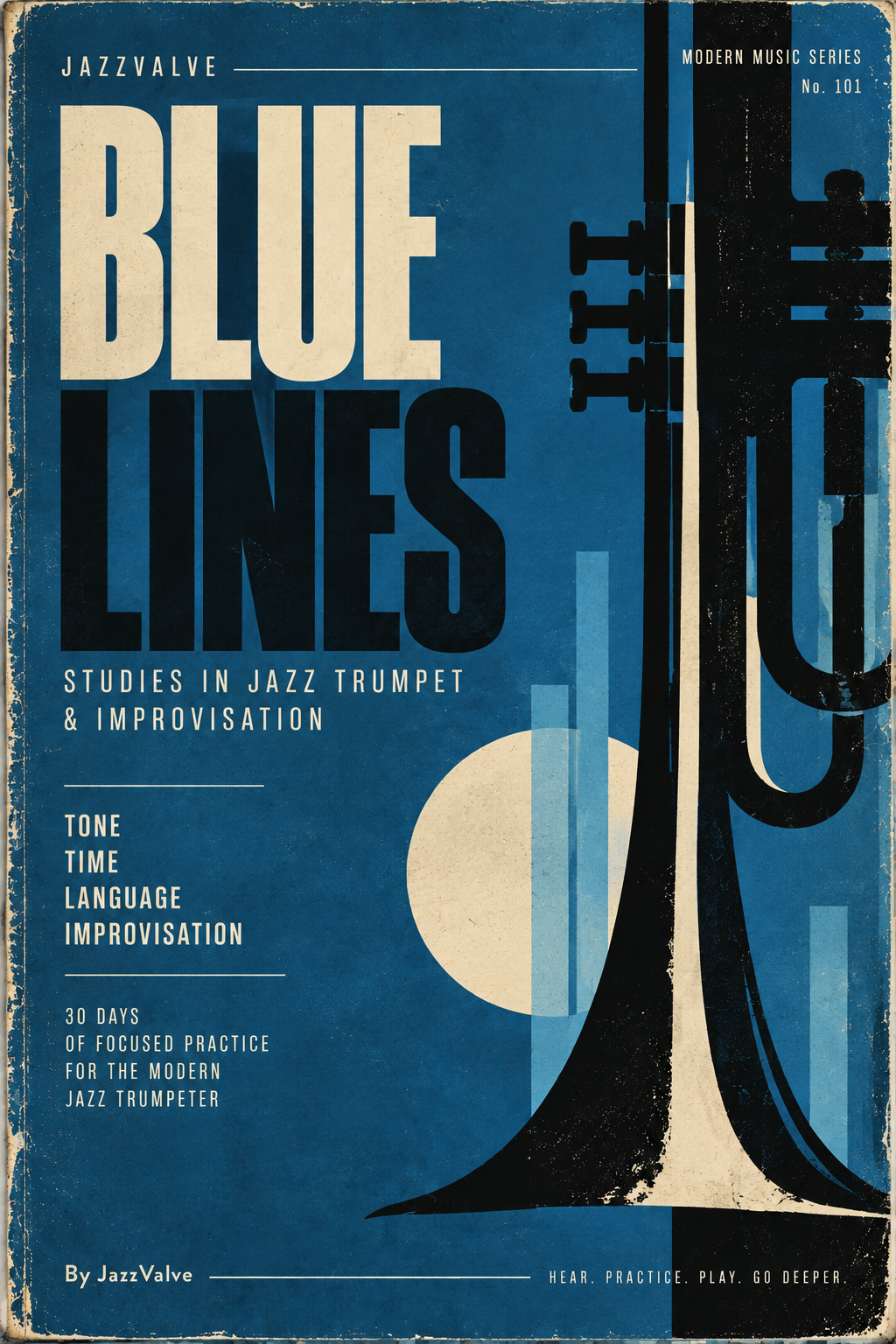
Blue Lines
Thirty days of focused B♭ trumpet practice: tone, time, jazz language and improvisation.
Email signup required
Get Blue Lines freeSecondary dominants help you hear where a chord is going, not just which notes it contains. On trumpet, that can mean noticing one changed note and aiming it at the next chord before you think about a whole scale.
This lesson is for players who can read basic seventh-chord symbols and want to understand unexpected dominant chords in a major-key chart. All pitches and chord symbols are written for B-flat trumpet, except the explicitly labeled concert-accompaniment progressions. Written C sounds concert B-flat, a whole step lower.
What is a secondary dominant?
A secondary dominant is a major triad or dominant-seventh chord acting as the dominant of a chord other than the home tonic. It briefly makes that other chord sound like a destination. This local emphasis is called tonicization; it does not by itself establish a lasting change of key. Robert Hutchinson's explanation of tonicization introduces this distinction between the home tonic and a temporary target.
In written C major, compare these two moves:
| Chord movement | Destination | Function in C major |
|---|---|---|
| G7 → Cmaj7 | C, the home tonic | Primary dominant: V7 → Imaj7 |
| D7 → G7 | G, the dominant of C | Secondary dominant: V7/V → V7 |
D7 contains D–F-sharp–A–C. Its F-sharp is outside the C-major scale and helps point toward G. G7 contains G–B–D–F; it already belongs to C major and points toward C. Both are dominant-seventh chords, but they have different jobs in this key.
If the difference between a plain 7, maj7 and m7 is still uncertain, start with the jazz chord-symbol guide.
JazzValve
Practice This In JazzValve
Open in the app →
Read the destination after the slash
Read V7/V aloud as “five-seven of five.” The numeral after the slash identifies the target; the part before it identifies that target's dominant. This is Roman-numeral analysis, not a bass-note instruction like D7/F-sharp. Open Music Theory's applied-chord chapter explains this notation.
In written C major:
- V7/V targets G: the chord is D7.
- V7/vi targets A minor: the chord is E7.
- V7/ii targets D minor: the chord is A7.
The last example appears in the turnaround-lick lesson. Here, use the first two to practise recognizing a destination rather than memorizing another A7 phrase.
Do not label every chord with a 7 as a secondary dominant. First establish the home key, then consider the chord's relationship to its target. The same E7 could be a secondary dominant in C major or the primary dominant in A minor.
Study 1: Find the dominant of the dominant
The first original study uses Cmaj7 | D7 | G7 | Cmaj7, with one chord per bar. Before playing, say “home, toward G, toward C, home.” The important move is F-sharp4 at the end of bar 2 to G4 at the start of bar 3.
Read the note and rhythm transcript below. Staff notation requires JavaScript.
Notes, rhythm and playing instructions
- Bar 1: beat 1, chord Cmaj7, C4 quarter note, sounds B-flat3; beat 2, E4 quarter note, sounds D4; beat 3, G4 half note, sounds F4.
- Bar 2: beat 1, chord D7, D4 quarter note, sounds C4; beat 2, A4 quarter note, sounds G4; beat 3, F-sharp4 half note, sounds E4.
- Bar 3: beat 1, chord G7, G4 half note, sounds F4; beat 3, F4 quarter note, sounds E-flat4; beat 4, D4 quarter note, sounds C4.
- Bar 4: beat 1, chord Cmaj7, E4 half note, sounds D4; beat 3, half rest.
Written for B-flat trumpet; notes and chord symbols sound a major second lower. Hear F-sharp4 resolve up to G4. D7 is V7/V; G7 is the primary V7. F4 in bar 3 is natural. Hold the final E4 for two beats, then rest for two beats. Concert accompaniment: B-flatmaj7 | C7 | F7 | B-flatmaj7.
Use 4/4, quarter note = 60, with a metronome click on every beat. Play the quarters and halves evenly; there are no swung eighth notes in these studies. A quarter note lasts one beat; a half note lasts two. C4 is middle C below the treble staff. Both studies stay within written C4–B4.
| Bar | Written chord | Exact written notes and durations |
|---|---|---|
| 1 | Cmaj7 | C4 quarter, E4 quarter, G4 half |
| 2 | D7 | D4 quarter, A4 quarter, F-sharp4 half |
| 3 | G7 | G4 half, F4 quarter, D4 quarter |
| 4 | Cmaj7 | E4 half, half rest |
Each bar totals four beats. Count the final rest; then rest longer before repeating if needed. You can also learn bars 2–3 alone, taking a full bar off between attempts. Do not force a four-bar breath.
For accompaniment, use concert B-flatmaj7 | C7 | F7 | B-flatmaj7, one bar each. A generic concert B-flat major backing track may have different changes; it is not automatically a match. A metronome alone is enough to learn the notes. Matching chords on a keyboard or accompaniment help you hear their function.
Now make one controlled comparison: replace bar 2's D7 with Dm7, and play F4 instead of F-sharp4. Keep everything else unchanged. The concert chord in that bar becomes Cm7. Compare F–G with F-sharp–G: the first rises a whole step, the second a half step. Restore D7 and its F-sharp afterward. This is the difference between the ordinary ii7 and V7/V here, not a license to swap them without checking the chart.
JazzValve
Practice This In JazzValve
Open in the app →
Study 2: Recognize a minor destination
A secondary dominant can point toward a minor chord. In the next study, E7 leads to Am7, the vi7 chord in written C major. E7 is E–G-sharp–B–D; G-sharp is the note to notice. The target chord is A–C–E–G, so its G is natural again.
Read the note and rhythm transcript below. Staff notation requires JavaScript.
Notes, rhythm and playing instructions
- Bar 1: beat 1, chord Cmaj7, C4 quarter note, sounds B-flat3; beat 2, E4 quarter note, sounds D4; beat 3, G4 half note, sounds F4.
- Bar 2: beat 1, chord E7, E4 quarter note, sounds D4; beat 2, B4 quarter note, sounds A4; beat 3, G-sharp4 half note, sounds F-sharp4.
- Bar 3: beat 1, chord Am7, A4 half note, sounds G4; beat 3, G4 quarter note, sounds F4; beat 4, E4 quarter note, sounds D4.
- Bar 4: beat 1, chord Cmaj7, E4 half note, sounds D4; beat 3, half rest.
Written for B-flat trumpet; notes and chord symbols sound a major second lower. Hear G-sharp4 resolve up to A4. E7 is V7/vi. G4 in bar 3 is natural. Hold the final E4 for two beats, then rest for two beats. Concert accompaniment: B-flatmaj7 | D7 | Gm7 | B-flatmaj7.
Keep the same meter and tempo. The opening and ending stay the same so you can concentrate on the changed middle.
| Bar | Written chord | Exact written notes and durations |
|---|---|---|
| 1 | Cmaj7 | C4 quarter, E4 quarter, G4 half |
| 2 | E7 | E4 quarter, B4 quarter, G-sharp4 half |
| 3 | Am7 | A4 half, G4 quarter, E4 quarter |
| 4 | Cmaj7 | E4 half, half rest |
For accompaniment, use concert B-flatmaj7 | D7 | Gm7 | B-flatmaj7, one bar each. Every bar again totals four beats.
Before playing, sing or hum the sound of the written G-sharp–A arrival in a comfortable register. If checking it on a piano, use concert F-sharp–G. On the horn, let G-sharp lead into A without making A louder just because it is the target. In bar 3, return to G-natural on beat 3; do not carry the previous bar's sharp into the Am7 sound.
These two melodies choose the dominant's third rising a half step to the next root. That is one useful route, not a rule for every jazz line. For example, D7–G7 can also support F-sharp–F-natural, moving from D7's third to G7's seventh. Open Music Theory discusses this alternative when an applied dominant resolves to another seventh chord. The guide-tone lesson develops other small connections.
Transfer the idea to a chart
Choose a short passage from a chart you are already learning. Work without the horn first:
- Confirm the pitch system. Are its chord symbols concert pitch or written for B-flat trumpet?
- Establish the local home key. A key signature alone may not explain every passage.
- Circle a possible dominant and look ahead. For a straightforward example, its target root will be a perfect fifth below it, or a perfect fourth above it. D points to G; E points to A.
- Check the chord quality and context. Dm7 is not the same chord as D7. If the expected target does not appear, do not force this beginner analysis onto the passage.
- Mark one arrival note and its beat. Play only the approach and arrival, leaving the rest silent. Add the surrounding melody afterward.
The quality-and-root checks follow the approach in Hutchinson's Analyzing Secondary Dominants. Real charts can delay or redirect a resolution; start with a clear adjacent pair before tackling those cases.
For a broader short-session routine, Blue Lines is a free trumpet workbook available with email signup.
Finish by covering the note tables and answering three questions: where does D7 point in Study 1, where does E7 point in Study 2, and why is G7 not secondary in the first study? Then play just the two half-step arrivals. If you can name the destinations and reach them in time, the symbols are starting to mean something you can hear.
JazzValve
Practice This In JazzValve
Open in the app →
Free trumpet workbook
Blue Lines
Thirty days of focused B♭ trumpet practice: tone, time, jazz language and improvisation.
Email signup required
Get Blue Lines freeSources
- Music Theory for the 21st-Century Classroom: Tonicization
- Open Music Theory: Applied chords
- Music Theory for the 21st-Century Classroom: Analyzing Secondary Dominants