Technique · October 20, 2026
By Justin Comstock · JazzValve creator, longtime guitarist and adult trumpet learner · Updated October 22, 2026
Trumpet Long Tones: Sound, Tuning and Phrase Endings
Practice short sustained notes with precise releases, tuner and drone checks, modest dynamic changes and a phrase that carries the sound into music.

Free trumpet workbook
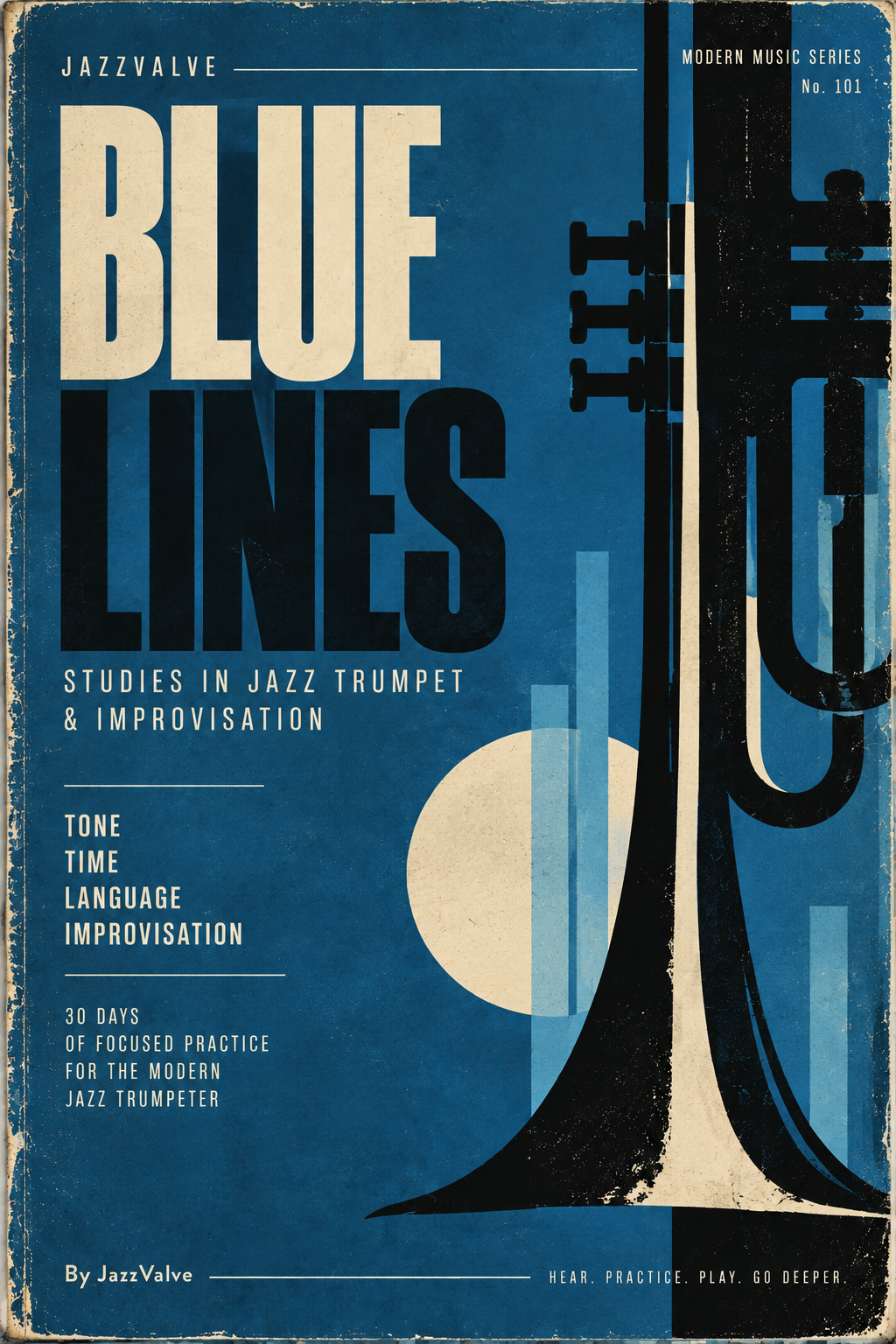
Blue Lines
Thirty days of focused B♭ trumpet practice: tone, time, jazz language and improvisation.
Email signup required
Get Blue Lines freeTrumpet long tones give you time to hear the beginning, middle and ending of a single note. For a jazz player, that attention matters when a phrase ends on a held pitch: the note still needs shape, steady time and an intentional release.
Start with a note you can already play comfortably. This lesson uses short sustained notes with generous rests, then carries the same listening task into a phrase. It is a sound study, not a test of how long you can keep blowing.
Set up one comfortable note
All pitches here are written for B-flat trumpet. Written G4 is the second line of the treble staff, F4 the first space and E4 the first line. Written G4 sounds concert F4. A concert-pitch tuner or drone must therefore show F when you play that written G.
Use the B-flat trumpet transposition guide if your tuner or accompaniment labels notes differently. A tuner set to transpose for B-flat trumpet may display the written name instead; check its setting before changing your pitch.
Choose G4 if it speaks easily, or use E4 or F4 instead. Stay at a comfortable medium-soft volume. Take an ordinary comfortable breath and begin without forcing a large attack. Follow your teacher's existing warm-up guidance; do not replace an individualized plan with a longer endurance drill.
Jeff Conner's trumpet teaching guidance for Yamaha emphasizes steady airflow and a consistent sound on sustained and changing notes. These original studies turn that listening goal into short, counted tasks.
JazzValve
Practice This In JazzValve
Open in the app →
Study 1: Give the release a precise place
Set the metronome to quarter note = 60 in 4/4.
- Bar 1: Play G4 as a half note on beat 1. Release at beat 3, then rest for beats 3 and 4.
- Bar 2: Rest for all four beats.
That is two beats of playing and six beats of rest. Listen through the silence. Did the note end exactly at beat 3, or did it trail past the click?
Try three cycles, putting the horn down briefly between attempts if needed. Keep the same pitch and volume. A clean, comfortable two-beat note is enough for this first check.
On the next pass, record one cycle. Listen separately to the attack and the release. If the beginning is uneven, isolate that instead of adding more seconds to the note.
Extend the note only when the sound stays comfortable
Try G4 as a whole note in bar 1, releasing at the start of bar 2. Rest throughout bar 2. Count “1, 2, 3, 4” internally while sustaining; do not let the last beat disappear.
If the sound thins or the breath feels forced before the release, return to the half-note version. Tennessee Tech professor Joshua Hauser's brass warm-up guidance treats comfortable tempo and consistent sound as important constraints. Longer is not automatically better.
Study 2: Hear pitch before watching a tuner
Use the whole-note-and-rest pattern on G4, or the shorter version if you prefer.
First listen without watching a display. Then check one attempt with a tuner. Notice whether the middle of the note is stable and whether the pitch moves at the release. A tuner is feedback about pitch, not a score for tone quality.
If you use a drone, choose concert F for written G. Listen to both sounds at a comfortable volume. Avoid making the trumpet louder simply to cover the reference.
Repeat the comparison with F4 and E4:
| Written trumpet pitch | Concert-pitch reference |
|---|---|
| G4 | F4 |
| F4 | E-flat4 |
| E4 | D4 |
Use a separate two-bar cycle for each pitch. Change the reference between cycles if you are matching a drone; a single concert F drone will not be a unison reference for all three notes.
Keep the task small: identify one note whose middle stays steady. If you cannot produce a comfortable sound, stop the exercise and ask your teacher to check the setup rather than making repeated large embouchure changes on your own.
JazzValve
Practice This In JazzValve
Open in the app →
Study 3: Compare a level note with a shaped note
Once a four-beat note is easy, make two recordings on the same pitch.
Take A: A whole note at one comfortable volume, followed by a whole bar of rest.
Take B: A whole note that grows slightly over beats 1–2 and returns toward its starting volume over beats 3–4, followed by a whole bar of rest.
The change should be modest. Do not aim for your loudest or softest possible sound. Keep the four-beat duration unchanged, and finish before you need to squeeze out the last air.
Listen for three things:
- Does the pitch move when the volume changes?
- Does the center of the sound remain clear?
- Does the release still arrive at the beginning of the rest bar?
If Take B becomes unstable, go back to Take A. This comparison gives you information about a musical shape; it is not a requirement to add a swell to every held note.
Put the sustained sound at the end of a phrase
Read the note and rhythm transcript below. Staff notation requires JavaScript.
Notes, rhythm and playing instructions
- Bar 1: beat 1, E4 quarter note, fingering 1+2, sounds D4, separate attack, no accent prescribed; beat 2, G4 quarter note, fingering open, sounds F4, separate attack, no accent prescribed; beat 3, F4 half note, fingering 1, sounds E-flat4, separate attack, no accent prescribed.
- Bar 2: beat 1, E4 whole note, fingering 1+2, sounds D4, separate attack, no accent prescribed.
- Bar 3: beat 1, whole rest.
- Bar 4: beat 1, whole rest.
Show the full held ending and exact release into two full rest bars. Steady even pulse. No swung subdivision or fixed swing ratio added. Optional accompaniment only: written C7 sounds concert Bb7; Static optional accompaniment. Concert pitches in the transcript are references only; play the written pitches on B-flat trumpet. No audio playback or fixed swing ratio is implied.
Play this original four-bar study in 4/4 at the same tempo. All notes are written pitches.
- Bar 1: E4 quarter note, G4 quarter note, F4 half note.
- Bar 2: E4 whole note.
- Bar 3: Whole-bar rest.
- Bar 4: Whole-bar rest.
Play without accompaniment first. If you add a static chord, use written C7, which sounds as concert B-flat7. F is a non-chord tone over C7; its movement to E makes the held ending a useful listening target.
The E in bar 2 deserves the same attention as your isolated long tone. Do not let the preceding notes make it louder by accident. Keep counting until its release at bar 3.
On a second pass, use a small diminuendo on the E, but retain its full four beats. Compare that with the level version. Choose the shape you prefer rather than fading automatically because the phrase is ending.
For different attacks and note lengths, continue with the jazz trumpet articulation lesson. That is a separate task from sustaining the center of the note.
Keep a useful practice record
Write down the pitch, duration and one observation. For example: “Written G4, four beats at 60. Pitch stayed steady; release was late.” That tells you what to try next time.
A short session can include three half-note cycles, one tuner or drone comparison and one phrase recording. Rest whenever you need to. Stop if playing becomes painful or strained; an exercise should not be used to push through discomfort.
Long tones can be one focused part of a jazz trumpet practice routine, alongside listening, rhythm and harmonic work. The aim is to carry a dependable sound into music, not to spend the whole session on isolated notes.
For additional short daily practice ideas, Blue Lines is a free jazz trumpet workbook available with email signup. Finish with one clear thing to listen for tomorrow.
JazzValve
Practice This In JazzValve
Open in the app →
Free trumpet workbook
Blue Lines
Thirty days of focused B♭ trumpet practice: tone, time, jazz language and improvisation.
Email signup required
Get Blue Lines freeSources
- Jeff Conner, Yamaha: Fix It: Trumpet Teaching Tips — https://hub.yamaha.com/music-educators/instruments/winds-instruments/trumpet-pedagogy/
- Joshua Hauser, Tennessee Tech: B-flat Trumpet/Baritone TC Warmups — https://sites.tntech.edu/jhauser/brass-warmups-with-mp3-play-a-long-tracks/bb-trumpetbaritone-tc-warmups-with-mp3-play-a-long-tracks/