Technique · November 20, 2026
By Justin Comstock · JazzValve creator, longtime guitarist and adult trumpet learner · Updated November 20, 2026
Trumpet Practice Mute: How to Practice Quietly Without Forcing Your Sound
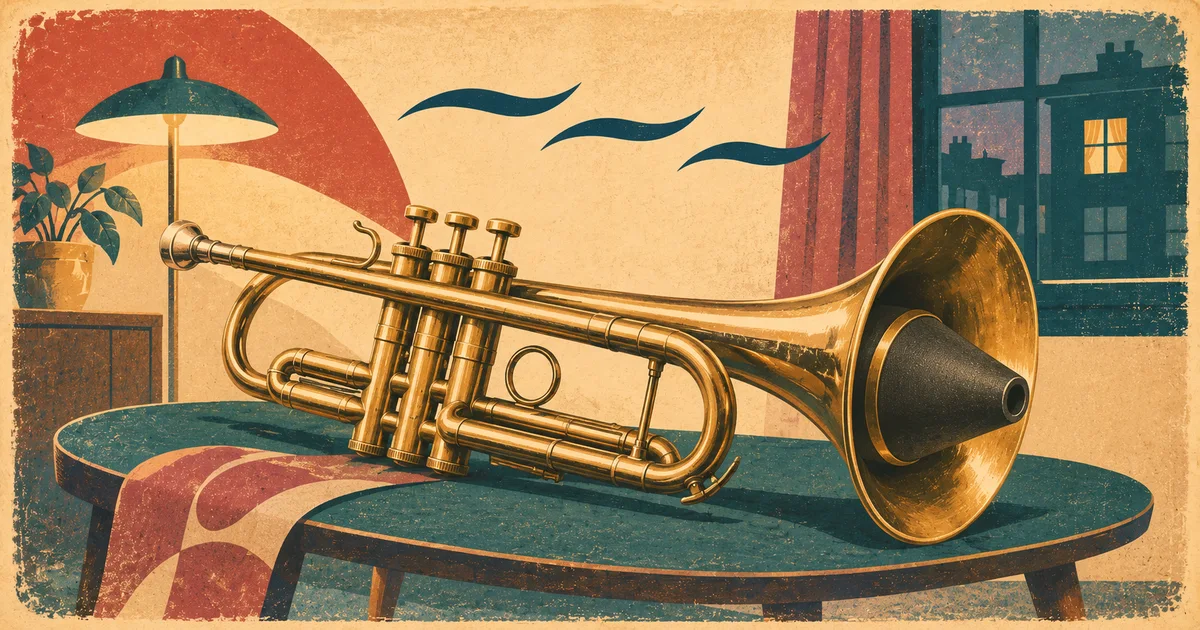
Keep practicing when you need to keep the volume down. Check mute fit, compare your response, and try a short B-flat trumpet drill with built-in rests.
Free trumpet workbook
Blue Lines
Thirty days of focused B♭ trumpet practice: tone, time, jazz language and improvisation.
Email signup required
Get Blue Lines freeThe apartment is quiet, you've got five minutes, and you want to work on one phrase. A trumpet practice mute can turn down the sound in the room, but the quieter sound can tempt you to blow harder than you normally would. Keep the goal small: one easy entrance, one clean valve change, or one ending that lands where you intended.
A practice mute makes a trumpet quieter, not silent. The sound outside your room depends on the instrument, the mute, how you play and the building. If you don't know what carries through a wall or door, check during a time when playing is already welcome. Headphones help you hear yourself; they don't tell you what a neighbor can hear.
Choose a mute for the job
A passive practice mute fits into the bell and works without electronics. It's the simpler setup if you just want a short, quieter practice block. Denis Wick's trumpet and cornet practice mute is an example of this design, not a ranking or a promise that it will fit every horn.
A pickup mute with headphones also reduces the sound in the room, but a microphone and electronics send a separate signal to your ears. In Yamaha's SILENT Brass system, the bell insert is the mute and the connected unit provides the headphone sound. Consider that type if the muffled sound makes it hard to hear your attacks or follow a backing track. Start with playback low enough to hear your own note without trying to play over it.
A straight, cup or Harmon-style mute is usually chosen for the color it gives a phrase. It isn't a substitute for checking how much your playing carries. For that separate job, see the JazzValve guide to performance mutes.
If you can try a practice mute before buying, check three things on your trumpet:
- Fit. Confirm that the maker lists your instrument as compatible. Install it as directed. It should sit securely without being wedged into the bell. If it shifts or feels unstable, stop and check the fit instead of pushing it farther in.
- Response. Play a familiar note at an easy dynamic. Does it start cleanly without extra effort? A different feel is normal; having to force each entrance is a reason to change the exercise or setup.
- Pitch. Try two or three comfortable notes, not just one. If you use a tuner, keep its concert or B-flat transposing setting consistent. Compare with your open trumpet at a time when you can play unmuted. Treat a shift as an observation, not a reason to clamp down or retune the horn on the spot.
JazzValve
Practice This In JazzValve
Open in the app →
A five-minute quiet practice block
This is a short practice idea after your usual warm-up, not a test of range or volume. At night, when you can't do an open comparison, use an easy sound you already know as your reference.
- Minute 1: Hear the pulse. Put the horn down and silently count four beats at a comfortable tempo, about 60 beats per minute. Finger the three notes below once without blowing.
- Minute 2: Check one entrance. With the mute in place, play an easy written F4 for two beats, then rest. Check that you didn't use more effort just because you heard less sound.
- Minutes 3–4: Play the two-bar phrase. Play one pass, leave at least two full bars of rest, and try a second pass only if the first still felt easy. Let the note lengths, not loudness, carry the shape.
- Minute 5: Put the horn down. Tap the rhythm and decide what improved. If the last note arrived late, practice counting its entrance silently instead of adding another round of playing.
Two bars: land on beat three
Use written B-flat trumpet pitches in 4/4 at quarter note = 60. The phrase is unaccompanied and uses an even pulse. A quarter note lasts one beat and a half note two. On the trumpet, E4 = valves 1 and 2, F4 = valve 1, and G4 = open. These notes sound concert D4, E-flat4 and F4, respectively. Valve 1 is the valve nearest the mouthpiece.
Read the note and rhythm transcript below. Staff notation requires JavaScript.
Notes, rhythm and playing instructions
- Bar 1: beat 1, E4 quarter note, fingering 1+2, sounds D4, light tongue; beat 2, F4 quarter note, fingering 1, sounds E-flat4, light tongue; beat 3, G4 half note, fingering open, sounds F4, light tongue.
- Bar 2: beat 1, quarter rest; beat 2, F4 quarter note, fingering 1, sounds E-flat4, light tongue; beat 3, E4 half note, fingering 1+2, sounds D4, light tongue.
Written B♭ trumpet, even pulse, unaccompanied. Lightly tongue each note. After the two-bar phrase, rest two complete bars before repeating; those extra rests are not shown.
- Bar 1: Beat 1, E4 quarter note (1+2); beat 2, F4 quarter note (1); beats 3–4, G4 half note (open).
- Bar 2: Beat 1, quarter rest; beat 2, F4 quarter note (1); beats 3–4, E4 half note (1+2).
- After the phrase: Rest for two complete bars. Lightly tongue each note and let the last E end with the bar. Don't play it louder to make the ending clearer.
The thing to hear is the shape across the rest: the rise to G makes a short question; the return to E answers it. At an appropriate daytime hour, you can play the same two bars unmuted once, at the same tempo and easy dynamic. Compare where each note starts and ends, rather than trying to make the two versions sound equally loud.
JazzValve
Practice This In JazzValve
Open in the app →
When to put the mute away
If your attacks get harder, your shoulders rise, or you keep taking bigger breaths to be heard, stop and rest. Try a shorter line in an easier register if the next attempt feels comfortable. If you have pain or the setup keeps making you strain, stop playing and check with your teacher rather than drilling through it.
And if the room really needs to stay quiet, leave the horn in its case. Listen to a phrase on headphones, tap its rhythm, then finger it silently. That gives you a real practice goal without having to test the walls.
Use a practice mute for the tasks it helps you hear and repeat comfortably. Save some unmuted time when you can, so the sound and feel you take to a rehearsal aren't based on the mute alone. For more short studies in tone, time and jazz phrasing, get the free Blue Lines workbook. Email signup is required.
Sources
- Yamaha: How SILENT Brass works
- Denis Wick: Practice Mute for Trumpet or Cornet
- Yamaha: Trumpet fingering chart (PDF)
JazzValve
Practice This In JazzValve
Open in the app →
Free trumpet workbook
Blue Lines
Thirty days of focused B♭ trumpet practice: tone, time, jazz language and improvisation.
Email signup required
Get Blue Lines freeSources
- https://www.deniswick.com/product/practice-mute-for-trumpet-or-cornet/
- https://hub.yamaha.com/winds/brass/how-yamaha-silent-brass-works/
- https://www.yamaha.com/en/musical_instrument_guide/common/images/trumpet/fingering.pdf