Technique · October 22, 2026
By Justin Comstock · JazzValve creator, longtime guitarist and adult trumpet learner · Updated October 22, 2026
Trumpet Intonation: Tune Low D and C-sharp in a Jazz Phrase
Separate overall tuning from note-specific corrections, map your third-valve slide, and practice low C-sharp to D in a minor-key jazz resolution.
Free trumpet workbook
Blue Lines
Thirty days of focused B♭ trumpet practice: tone, time, jazz language and improvisation.
Email signup required
Get Blue Lines freeTrumpet intonation becomes easier to work on when you separate two questions: is the instrument's general tuning off, or does one particular note need an adjustment? Moving the main tuning slide every time a low D sounds sharp mixes those problems together.
This lesson builds a small pitch map, then puts two common trouble spots into an original minor-key phrase. You need your trumpet, a tuner or reference tone, and a way to record a short attempt. Use your usual comfortable playing setup and warm up before checking pitch.
Check the note name before changing the pitch
All exercise pitches and chord symbols below are written for B-flat trumpet unless marked concert. C4 is middle C, just below the treble staff. A standard B-flat trumpet sounds a major second below the written note, as UTEP's transposition reference explains.
For these checks, put your tuner in concert-pitch mode and use the following targets:
| Written trumpet note | Concert tuner or matching reference |
|---|---|
| G4, second line | F4 |
| C5, third space | B-flat4 |
| D4, below the staff | C4 |
| C-sharp4, below the staff | B3 |
| E-flat4, first line with a flat | D-flat4 |
A tuner configured for B-flat trumpet may display the written name instead. Check the setting once, rather than trying to bend written G until a concert-pitch display says G. Agree on the reference tuning with your accompanist, too. A keyboard, backing track and tuner need a common starting point.
JazzValve
Practice This In JazzValve
Open in the app →
Separate the main slide from note-by-note adjustments
The main tuning slide changes the instrument's overall tube length. Pulling it out lowers the instrument's general pitch; moving it inward raises it. Yamaha's tube-length demonstration illustrates the underlying relationship between longer tubing and lower pitch.
After warming up, compare a comfortable written G4 with concert F4. Play at an ordinary, repeatable dynamic, listen, then check the tuner. Make any small main-slide change between attempts. If C5 is comfortable, compare it with concert B-flat4 as a second check.
Do not expect one slide setting to make every note automatically correct. Yamaha's explanation of trumpet valves and slides describes the fingerings as approximate pitch locations that still need fine adjustment.
Use these observations to choose the next step:
- Several comfortable notes consistently sit on the same side of their references: revisit the general tuning.
- G4 and C5 are close, but one lower note is consistently sharp: investigate that note separately.
- The same note changes widely between attempts: first make the attack, volume and sustained sound more repeatable. Keep a record rather than making a different large slide change after every reading.
The long-tone lesson helps with that last task. Here, the next step is learning which adjustment belongs to which fingering.
Map low D and C-sharp on your own horn
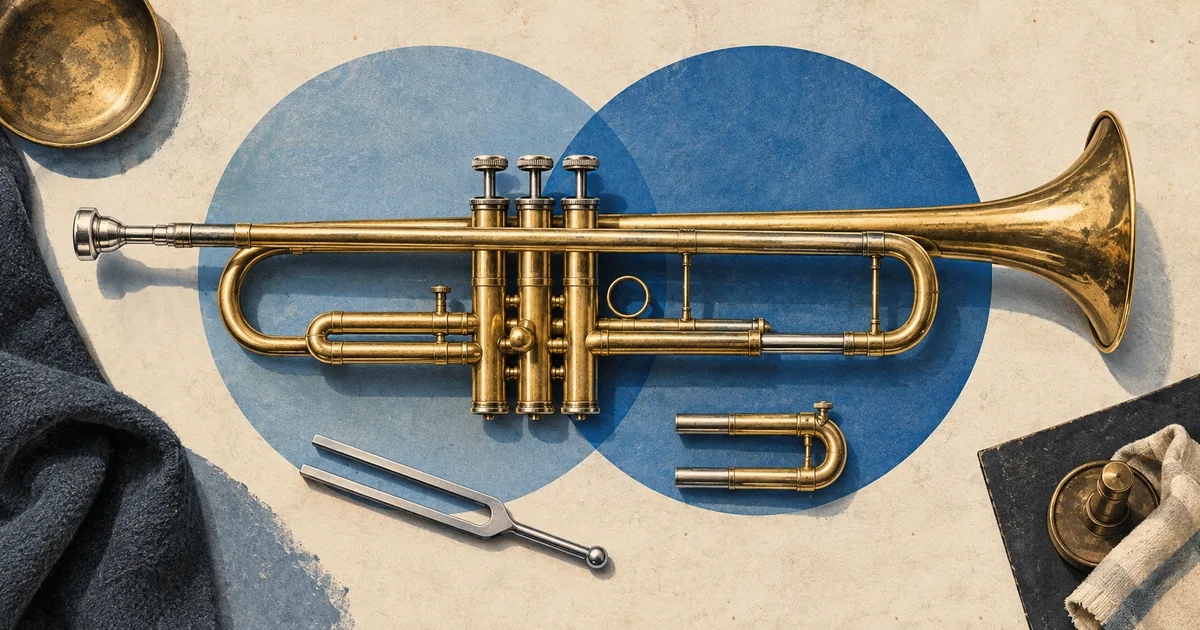
Written D4 uses valves 1–3; written C-sharp4 uses 1–2–3. Both commonly sit sharp with the third-valve slide in its normal resting position. Extending a movable third-valve slide adds tubing and lowers them.
Brian Weidner's trumpet chapter in Brass Techniques and Pedagogy treats slide movement as part of learning these fingerings. It also emphasizes that the required distance varies by instrument and player. Learn your sound rather than copying a universal measurement.
At quarter note = 72 in 4/4, play D4 for two beats, then rest for two. Use concert C4 as the reference. On a fresh attempt, compare the pitch with an appropriate small slide extension. Listen before looking at the display. Repeat the process separately for C-sharp4 against concert B3.
Write down a practical observation for each: “D needed some extension; C-sharp needed more.” Those are examples of notes you might make, not guaranteed results. Keep the main slide where you established it while comparing these two notes.
Use only a slide designed to move during playing. If it sticks, leave the mechanical problem to a teacher or repair technician instead of forcing it.
JazzValve
Practice This In JazzValve
Open in the app →
Practice returning the slide, too
A correction for one note is not a permanent new position for every fingering using that slide. Written E-flat4 uses valves 2–3. Return from the low-D extension when moving to E-flat, then check E-flat against concert D-flat4 on its own.
Try this original two-bar coordination pattern without accompaniment:
- Bar 1: D4 quarter note on beat 1; E-flat4 quarter on beat 2; D4 quarter on beat 3; quarter rest on beat 4.
- Bar 2: Rest for all four beats.
Use the D adjustment you found, return for E-flat, and restore the adjustment for the second D. Lightly tongue the notes so each arrival is easy to hear. The valves remain fully depressed for each fingering; this is not a half-valve effect.
If the slide arrives after the note and creates an unwanted pitch scoop, slow the coordination down. Rehearse one D-to-E-flat movement, rest, then reverse it. The target is a prepared arrival, not a dramatic correction that the listener can hear halfway through the note.
Put C-sharp and D into a jazz resolution
Use written A7 for one bar, followed by Dm7 for three bars. For concert-pitch accompaniment, that is G7 for one bar, followed by Cm7 for three bars. Begin unaccompanied if you are still learning the notes.
Play this original four-bar study in 4/4 at quarter note = 72:
- Bar 1, A7: E4 quarter note; G4 quarter note; C-sharp4 half note on beats 3–4.
- Bar 2, Dm7: D4 half note on beats 1–2; F4 quarter on beat 3; A4 quarter on beat 4.
- Bar 3, Dm7: D4 half note on beats 1–2; half rest on beats 3–4.
- Bar 4, Dm7: Whole-bar rest.
Read the note and rhythm transcript below. Staff notation requires JavaScript.
Notes, rhythm and playing instructions
- Bar 1: beat 1, chord A7, E4 quarter note, sounds D4; beat 2, G4 quarter note, sounds F4; beat 3, C-sharp4 half note, sounds B3.
- Bar 2: beat 1, chord Dm7, D4 half note, sounds C4; beat 3, F4 quarter note, sounds E-flat4; beat 4, A4 quarter note, sounds G4.
- Bar 3: beat 1, chord Dm7, D4 half note, sounds C4; beat 3, half rest.
- Bar 4: beat 1, chord Dm7, whole rest.
Written for B-flat trumpet. Quarter note = 72. Concert accompaniment: G7 | Cm7 | Cm7 | Cm7. Prepare the C-sharp slide position for bar 1 beat 3, then use the D position checked earlier; do not assume the same extension. Fingering and slide-distance symbols are intentionally omitted.
Every note in the sounding bars is a chord tone. C-sharp is A7's third and rises a half step to D, the next chord's root. That small melodic move makes the low-register tuning easy to notice.
Prepare the C-sharp slide position as you arrive on beat 3. At the next bar, change to the D position you checked earlier rather than holding exactly the same extension by habit. Let the rests give you time to reset before repeating.
Record the complete study with accompaniment. Listen especially to the C-sharp-to-D arrival and the final D. Can you hear both the trumpet and the backing, or are you covering the reference by playing louder? Use the tuner for an isolated recheck if needed, then return to the complete phrase.
Carry one finding into rehearsal
A useful practice result is specific: “The C-sharp was fine alone, but its slide adjustment arrived late in the phrase.” That tells you to work on preparation, not to retune the whole instrument.
When playing with a pianist, bassist or horn section, listen to their actual sustained pitches as well as your own. A green tuner reading is useful information, but it cannot make the ensemble listen together. Start with clear unisons and octaves before turning every chord into a separate tuning experiment.
Take one phrase from your repertoire and mark the low D or C-sharp that needs attention. Check that note alone, then restore the notes before and after it. For more short phrases to practice, the free Blue Lines workbook is available with email signup.
JazzValve
Practice This In JazzValve
Open in the app →
Free trumpet workbook
Blue Lines
Thirty days of focused B♭ trumpet practice: tone, time, jazz language and improvisation.
Email signup required
Get Blue Lines freeSources
- UTEP, Charles Leinberger: Instrument Transpositions for Musical Analysis — https://utminers.utep.edu/charlesl/transpose.html
- Yamaha: Gradually changing the length of the tube — https://www.yamaha.com/en/musical_instrument_guide/trumpet/mechanism/mechanism003.html
- Yamaha: How does the trumpet generate sound? — https://www.yamaha.com/en/musical_instrument_guide/trumpet/mechanism/mechanism002.html
- Brian N. Weidner, Brass Techniques and Pedagogy: The Trumpet — https://pressbooks.palni.org/brasstechniquesandpedagogy/chapter/the-trumpet/