Technique · November 20, 2026
By Justin Comstock · JazzValve creator, longtime guitarist and adult trumpet learner · Updated November 20, 2026
Trumpet vs. Flugelhorn: Same Notes, Different Sound
You can play the same written line on both B-flat horns. Here's what changes in the sound, what carries over, and what to check before switching.
Free trumpet workbook
Blue Lines
Thirty days of focused B♭ trumpet practice: tone, time, jazz language and improvisation.
Email signup required
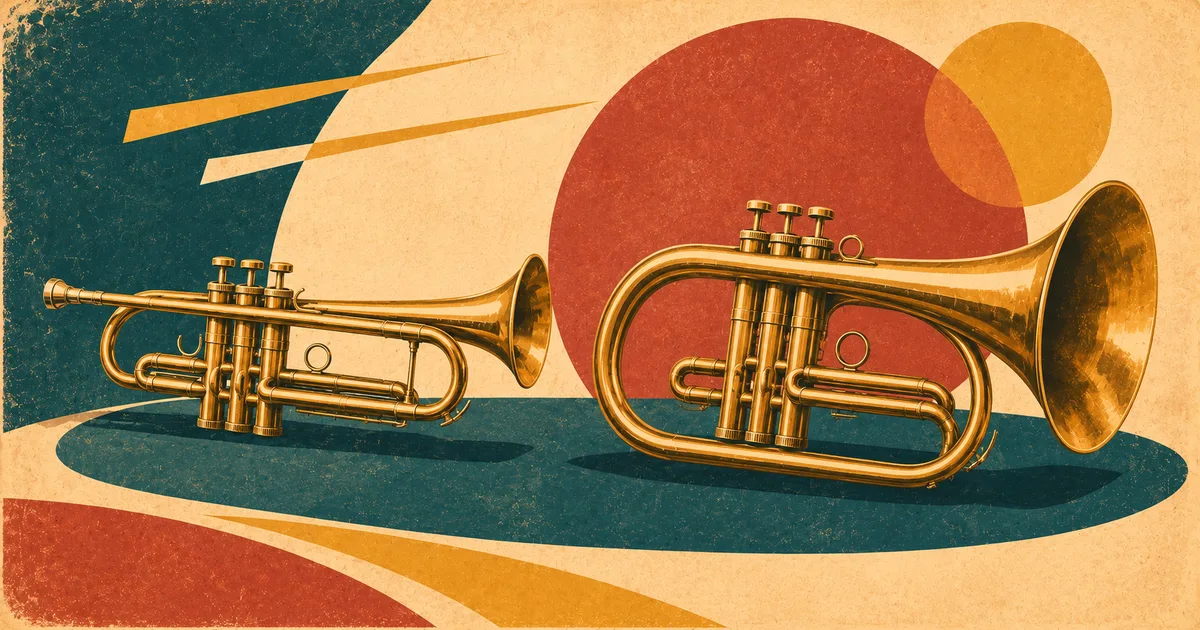
Get Blue Lines freeA B♭ trumpet and a B♭ flugelhorn can play the same written part using the same standard fingerings. What changes is the sound and how the notes feel when they start. The trumpet generally has a brighter edge; the flugelhorn tends toward a rounder, more mellow sound. Play the same four beats on both at the same easy volume. You'll hear more about the difference than you would by comparing how loud each can get.
JazzValve
Practice This In JazzValve
Open in the app →
What changes when you pick up a flugelhorn?
| Question | B♭ trumpet | B♭ flugelhorn |
|---|---|---|
| What does it usually sound like? | Brighter, with more edge to the center of the sound | Rounder and more mellow |
| What does a written C sound like? | Concert B♭, a whole step lower | The same concert B♭ |
| Can I use my normal fingerings? | Yes, for the standard B♭ trumpet range | Yes, for the familiar notes on a standard three-valve B♭ flugelhorn |
| Can I move my mouthpiece across? | Use the mouthpiece made to fit your trumpet | Use a mouthpiece with the shank specified for that flugelhorn |
The difference in tubing matters. A trumpet has more tubing that stays roughly the same diameter before the bell flare. A flugelhorn's tubing is more conical, meaning it widens progressively over more of its length. Yamaha's brass instrument guide connects that shape to the flugelhorn's mellower sound. That doesn't mean a flugelhorn must be quieter, or that a trumpet can't sound warm. Think of the instruments as different starting points for the sound you want.
A single bore number on a spec sheet doesn't describe the full taper. For instance, Yamaha's YFH-631G specs list the bore and bell diameter separately. Neither dimension alone tells you how the instrument will respond to your first note.
Can I read a trumpet part on flugelhorn?
Yes, if both instruments are in B♭. Written C4 (middle C, just below the treble staff) sounds as concert B♭3 on either. Written E4 sounds D4. If you already have a written B♭ part, read it as written. If a pianist hands you a concert-pitch melody, you still need to read or transpose it up a whole step. The switch to flugelhorn does not introduce another transposition.
Start with the familiar middle register. The fingerings transfer, but the point where a note settles in can feel different. If an entrance is fuzzy, stop and try a short, easy sound on the flugelhorn instead of blowing harder or adding mouthpiece pressure. Check a few sustained notes against a tuner if you're unsure how the instrument is sitting. Tune by the instrument's own instructions; for example, Yamaha's flugelhorn tuning guide uses the adjustable mouthpiece receiver on the design it shows.
JazzValve
Practice This In JazzValve
Open in the app →
Test the same phrase on both horns
This is an original two-bar comparison, not a range exercise. Play in 4/4 at quarter note = 72, with steady, straight eighth notes and light, separate note starts. All notes below are written for B♭ instruments.
Read the note and rhythm transcript below. Staff notation requires JavaScript.
Notes, rhythm and playing instructions
- Bar 1: beat 1, G4 quarter note, fingering open, sounds F4; beat 2, F4 eighth note, fingering 1, sounds E-flat4; beat 2.5, E4 eighth note, fingering 1+2, sounds D4; beat 3, D4 half note, fingering 1+3, sounds C4.
- Bar 2: beat 1, quarter rest; beat 2, E4 quarter note, fingering 1+2, sounds D4; beat 3, C4 half note, fingering open, sounds B-flat3.
Play the same written phrase on a B-flat trumpet and a B-flat flugelhorn if available. Straight eighths and light, separate note starts.
| Bar | Beats and notes | Valves |
|---|---|---|
| 1 | Beat 1: G4 quarter. Beat 2 and its offbeat: F4 and E4 eighths. Beats 3–4: D4 half. | Open, 1, 1+2, 1+3 |
| 2 | Beat 1: quarter rest. Beat 2: E4 quarter. Beats 3–4: C4 half. | Rest, 1+2, open |
G4, F4, E4, D4 and C4 sound as concert F4, E♭4, D4, C4 and B♭3, respectively. “Open” means no valves pressed. Check the same fingerings in Yamaha's trumpet chart or the JazzValve flugelhorn fingering chart.
Take a full breath before each pass, use the same comfortable volume, and keep the pause in bar two. If you record yourself, leave the phone in the same spot. First listen to the opening G: does the note have a distinct edge or a softer outline? Then listen to how the last C fades. If you mostly notice that one pass was louder, try once more at a closer volume before deciding which color you prefer. If you only own a trumpet, try two versions on that horn: one with a more defined entrance, and one gentler. That's a useful contrast without buying another instrument.
What to check before you switch
Start with the mouthpiece intended for that instrument. The shank is the tapered end that goes into the receiver. Even among flugelhorn mouthpieces it comes in different fits: Denis Wick lists standard and European shanks in its range. A familiar rim shape is not evidence that the shank fits. Ask the instrument maker or a brass technician if you don't know what fits your particular horn. Never force a mouthpiece that won't seat normally.
For a jazz ballad, try a flugelhorn if its rounder sound fits the space you're trying to leave around the melody. For an ensemble entrance that needs more definition, start by trying the trumpet. These aren't rules about repertoire. The useful question is which sound carries the phrase with the least extra effort for you.
If you're still building reliable entrances and valve changes, stick with the trumpet you already have. Get the free Blue Lines workbook for short B♭ trumpet studies you can use on either horn once the part and range suit it. Email signup is required.
JazzValve
Practice This In JazzValve
Open in the app →
Free trumpet workbook
Blue Lines
Thirty days of focused B♭ trumpet practice: tone, time, jazz language and improvisation.
Email signup required
Get Blue Lines freeSources
- https://hub.yamaha.com/winds/brass/the-brass-family-explained/
- https://usa.yamaha.com/products/musical_instruments/winds/flugelhorns/yfh-631g/specs.html
- https://faq.yamaha.com/usa/s/article/000001240
- https://www.yamaha.com/en/musical_instrument_guide/trumpet/play/play002.html
- https://www.deniswick.com/flugelhorn/