Technique · October 20, 2026
By Justin Comstock · JazzValve creator, longtime guitarist and adult trumpet learner · Updated October 21, 2026
Your First Jazz Jam Session on Trumpet: What to Prepare
Prepare a few suitable tunes, agree on the concert key, understand your role and keep listening through the form at your first jazz jam session.

Free trumpet workbook
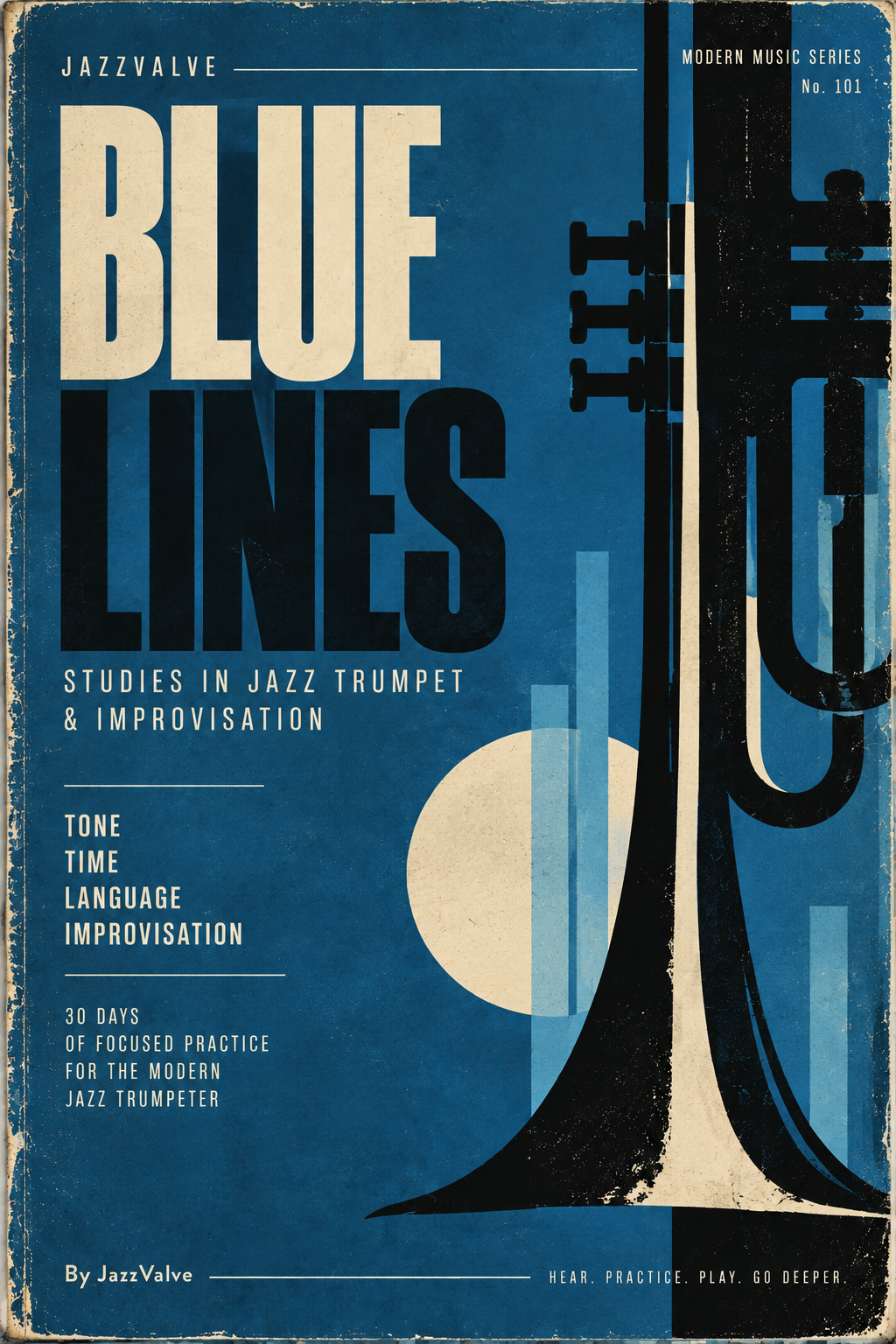
Blue Lines
Thirty days of focused B♭ trumpet practice: tone, time, jazz language and improvisation.
Email signup required
Get Blue Lines freeFor your first jazz jam session on trumpet, prepare a small amount of music thoroughly and find out how that particular session works. Knowing the melody, form and concert key of a few suitable tunes gives you something concrete to offer. Listening and communicating help you use that preparation with other people.
Ask the host what the session expects
Check the organizer's current description before going. Is the session intended for newer players, experienced musicians or a particular style? Does it use a sign-up list? Are charts welcome? Who decides which tunes to play?
A listening visit can help. If information is missing, ask the host: “I play B-flat trumpet and I'm new to jam sessions. What should I prepare before sitting in?” Tell them what you can already play rather than guessing what level label fits you.
Session rules differ. For example, the Austin Swing Syndicate's published musician guidelines describe a leader-managed, dance-focused session with sign-ups and player rotation. Those are that organizer's arrangements, not requirements at every jazz session. Follow the actual host's process and wait for an invitation to join the bandstand.
Choose a small, usable repertoire
Ask which tunes fit the session, then prepare two or three possibilities. Having a backup helps if your first choice has already been played or does not fit the group that is up next.
For each tune, make a private preparation card with:
- Title and the recording or chart you studied.
- Concert key and your written trumpet key.
- Form, including any repeated sections or pickups.
- A comfortable tempo and the intended feel.
- Where the melody starts and how the version you know ends.
- One section you still need to practise.
If the host selects a different key, tempo or version, decide honestly whether you can follow it. Sitting out one tune is better than pretending you know it.
The easy jazz repertoire guide can help you choose material to study.
JazzValve
Practice This In JazzValve
Open in the app →
Prepare the melody and the form separately
First play the melody at a comfortable tempo. Then put the trumpet down and follow the form while listening. Can you identify the next section before it arrives? Can you keep your place through a passage where you are not playing?
For a twelve-bar blues, practise counting an entire chorus without filling the space. For a longer tune, mark its actual sections rather than assuming every standard is thirty-two bars. The blues form lesson provides a focused starting point if twelve-bar counting is new.
Next, rehearse a modest solo using only notes and rhythms you can control. Record a complete pass through the form. Check your beginning and ending before judging how interesting the middle sounds.
Make the concert key unambiguous
A standard B-flat trumpet sounds a major second below its written notes, as the UTEP transposition reference explains. Written C sounds concert B-flat. If the band agrees on a tune in concert B-flat major, your B-flat trumpet part is written in C major.
Use the word “concert” when discussing the sounding key. Saying only “I play it in C” can leave a pianist and trumpeter thinking about different pitches. A useful clarification is: “Concert B-flat, so written C for my trumpet?”
Bring your own appropriate B-flat part if the session allows charts and you need one. Do not hand that transposed trumpet chart to a pianist and assume it shows concert harmony. If you are providing charts for other musicians, confirm which pitch version each needs and use music you are entitled to share.
Before the count-in, clear up any mismatch. The trumpet transposition guide gives more examples to practise at home; the bandstand is a difficult place to discover that you have been reading a different key.
Confirm your role before the tune starts
Ask whether you are playing the melody, taking a solo, or both. With multiple horns, find out who leads the melody and whether you are meant to join it. Avoid adding an unplanned harmony part just because you can find notes that fit.
Jazz Night School's guide to jam-session basics describes a common melody–solos–melody arrangement while noting that formats vary. It also points out that some tunes use different harmony for the solo section. Listen to the instructions for this performance rather than assuming the chart repeats unchanged.
Clarify an unfamiliar introduction or ending in one short question. If someone calls for a vamp, ask what repeats and who cues the melody. If you do not understand the instruction, asking before the first beat is useful preparation, not a musical failure.
JazzValve
Practice This In JazzValve
Open in the app →
Listen actively during other solos
When another player takes over, lower the trumpet and keep following the tune. Listen for the phrase, the rhythm section and the approaching end of the form. Stay where you can see the leader without blocking another musician.
Elon University's horn-player guidance emphasizes following the form, avoiding practice noises during others' solos and using eye contact around transitions. Its detailed local recommendations need not match another session; the listening responsibility still matters.
Do not treat the next solo as time to test a lick quietly. Unless the group has agreed on backgrounds, leave room and be ready for your next assigned entrance.
Keep the handoff clear
Follow the host's guidance on solo length. There is no single chorus count appropriate to every tempo, tune and session. If you are unsure, ask before playing and choose something manageable.
As your final chorus approaches its end, look toward the next player or leader and finish a phrase deliberately. Avoid launching another chorus while signaling that you are done. Likewise, wait until the previous solo has actually finished before entering.
If you lose your place, stop adding notes. Listen for a section boundary or a cue and rejoin when you know where you are.
Leave with one useful next step
After playing, thank the musicians and follow the host's direction about leaving the stand or staying for another tune. Ask a specific question during an appropriate break, such as whether your final entrance matched the return to the melody.
Write down one thing that worked and one thing to prepare for next time.
For additional short practice ideas between sessions, Blue Lines is a free jazz trumpet workbook available with email signup. Build toward the next visit with one concrete musical task, while continuing to listen to the people you hope to play with.
JazzValve
Practice This In JazzValve
Open in the app →
Free trumpet workbook
Blue Lines
Thirty days of focused B♭ trumpet practice: tone, time, jazz language and improvisation.
Email signup required
Get Blue Lines freeSources
- Jazz Night School: Jam Session Basics — https://jazznightschool.org/pages/jam-session-basics
- Elon University Jazz Studies: Jam Session Etiquette for Horn Players — https://www.elon.edu/u/academics/arts-and-sciences/jazz-studies/jam-session-etiquette-for-horn-players/
- Austin Swing Syndicate: Musician Guidelines and Etiquette — https://austinswingsyndicate.org/wp-content/uploads/2015/05/JammingGuidelines.pdf
- Charles Leinberger, UTEP: Instrument Transpositions for Musical Analysis — https://utminers.utep.edu/charlesl/transpose.html