Technique · October 25, 2026
By Justin Comstock · JazzValve creator, longtime guitarist and adult trumpet learner · Updated October 25, 2026
How to Memorize Jazz Standards on Trumpet
Learn one jazz standard with a melody, form and harmony map, then test your recall from several starting points without relying on the chart.

Free trumpet workbook
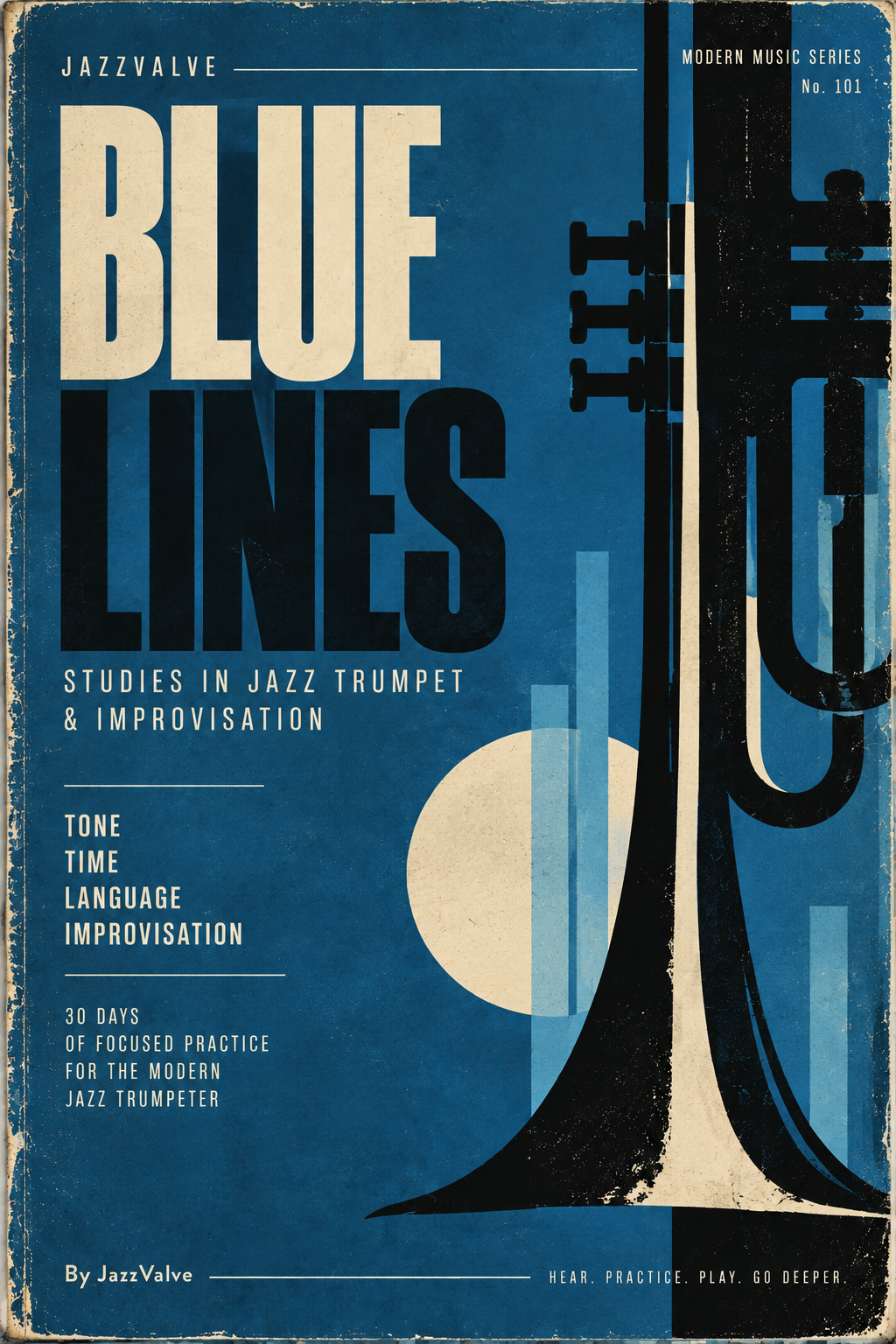
Blue Lines
Thirty days of focused B♭ trumpet practice: tone, time, jazz language and improvisation.
Email signup required
Get Blue Lines freeTo memorize jazz standards on trumpet, learn more than the route your fingers take from the first note. Build a small map of the melody, form and harmony, then practise finding your place without the chart or recording supplying the next answer.
Choose one tune you can already play slowly and comfortably with a chart. This lesson is about retaining a whole standard and entering it from several places, not learning a first phrase by ear or transcribing a solo. If the melody is still unfamiliar, begin with the short-phrase ear-training lesson, then return here.
Choose one version and label the key
Save the tune title, composer, chart source and one reference recording. Note the recording's performer and exact version. An introduction, altered ending or reharmonization belongs to that arrangement; it may not appear in the chart another player brings.
Check whether your chart is in concert pitch or written B-flat trumpet pitch. A standard B-flat trumpet sounds a major second below its written notes: written C4 sounds concert B-flat3. To convert a concert-pitch part for B-flat trumpet, write it a major second higher. The UTEP transposition reference confirms that relationship.
Label your notebook accordingly. Keep concert key and written trumpet key on separate lines so you can communicate with a rhythm section without silently switching systems. The trumpet transposition guide provides a fuller check. If chart and recording are in different keys, resolve that before treating a pitch disagreement as a memory failure.
JazzValve
Practice This In JazzValve
Open in the app →
Make a section map before memorizing every detail
Count the recurring form using your chosen chart and recording. Write the section order and actual bar counts. Keep introductions, tags and endings separate from the repeated chorus unless this arrangement includes them there.
The Herbie Hancock Institute's Jazz in America form lesson describes a chorus as one complete trip through the form. Its examples include AABA, ABAC and twelve-bar blues. These are useful possibilities, not a reason to force every tune into thirty-two bars.
For a tune you have verified as four eight-bar sections in AABA order, a working map could read:
- Bars 1–8: first A.
- Bars 9–16: second A.
- Bars 17–24: B, the contrasting section or bridge.
- Bars 25–32: final A.
This is a form template, not the chart for a particular standard. Replace its labels and lengths when your tune differs. Similar sections can have different last measures, so label their exits as well as their beginnings.
Add one audible landmark to each section: a recognizable melodic entrance, a held note, a change of harmonic area or a distinctive ending. Use details you can hear and verify. “The bridge starts here” is a label; “I can sing its opening without hearing the preceding section” is a usable recall cue.
Learn the melody in sections, then test the joins
With the horn down, sing or hum one section in a comfortable range. Check it against the reference. Then play that section slowly, preserving its rhythm and rests rather than reducing it to a string of pitches.
Put the chart out of sight for one attempt. If you lose a detail, pause and identify where it happened. Look at that spot, listen again if needed, then try the short passage without looking. Guessing through the same uncertain ending is not the goal.
When two sections work separately, practise their join: the last phrase of one section into the first phrase of the next. Include the full rests and any pickup. Do not count a pickup as an extra complete bar or shorten the silence to reach a familiar note sooner.
Give repeated sections special attention. If the first A leads to another A but the second leads to the bridge, practise those two exits separately. Write a cue that distinguishes them. You want to remember which ending belongs here, not simply replay whichever ending your fingers expect.
Add a harmony map without losing the pulse
First say the chord names from your checked chart while following its bar lengths. Then cover a section and try recalling its changes. If that is too much, begin with the first chord of each section and its destination, then fill in the connecting harmony.
Keep both chord quality and duration. Remembering a root alone does not distinguish a major-seventh chord from a dominant-seventh chord. Likewise, a correct sequence played with the wrong number of beats is not the tune's progression.
In Focus on the Framework, saxophonist Bob Reynolds emphasizes knowing form and harmony without depending on a play-along. Apply that principle here by checking a short section without accompaniment. Say its chord names in time, or play its roots in a comfortable register while counting the actual chord durations. Use a metronome on every beat if that helps; this is not a test of sparse-click timekeeping.
If you already understand thirds and sevenths, use the guide-tone lesson to plan a simple path through a difficult connection. Do not substitute an unrelated memorized ii–V–I for the changes actually in your tune. Mark uncertain harmony for a teacher or experienced player to check.
JazzValve
Practice This In JazzValve
Open in the app →
Make entry-point cards instead of always starting at bar one
Create one small card for each section. On the front, put only the section label and bar number. On the back, record the checked opening melody cue, starting harmony and the section's exit cue.
Shuffle the cards. Draw one, name the section's place in the form, hear its opening, and sing or play from that point. Check the back only after the attempt. A card that already shows the answer tests recognition more than unaided recall.
Start at section boundaries, not arbitrary difficult beats. Later, add a card for a transition that repeatedly breaks down. These cards are a practice aid, not a replacement for listening to the whole tune.
Finish by linking the sections in order once. Starting anywhere is useful only if you can also connect the whole form. Record a slow pass, then listen with the chart: check section lengths, different endings, pitch and rhythm separately.
Repair the kind of memory lapse you actually had
- You know the notes but lose your place: speak the section labels and count through one chorus without playing.
- You confuse two similar sections: compare their final phrases and practise each into its correct destination.
- You can sing it but cannot play it: isolate the instrumental transition at a comfortable tempo, with rests between attempts.
- You can play along but not alone: alternate a short supported attempt with a chart-free, unaccompanied attempt.
- The harmony disappears while the melody continues: rehearse the chord map separately before combining the tasks again.
During this private practice, stop to repair a gap rather than disguising it with extra notes. In an ensemble, keep listening and counting, and re-enter at a landmark you recognize instead of restarting the tune over the band.
Check recall after a gap
Before opening the chart at your next session, write the form and try one entry-point card. Then verify the result. The Learning Scientists explain retrieval practice as bringing learned material to mind and checking it afterward. Applying that general learning principle to these tune checks is a practice suggestion, not a promise that every standard will stay memorized after a fixed number of repetitions.
Try another check the following day and again several days later. Adjust the interval when recall is unreliable. A brief successful test after a gap tells you something different from ten immediate repetitions while the chart is still fresh.
Keep a repertoire log with the tune, concert and written keys, reference version, last chart-free check and one repair target. “Bridge entrance uncertain” is more useful than “needs work.” Avoid marking a tune permanently finished after one successful run.
For today's session, aim to leave with a checked section map, two entry-point cards and one transition to revisit. Take breaks from playing; singing, counting and checking your notes are part of the work. For separate original playing material, the free Blue Lines workbook is available with email signup.
JazzValve
Practice This In JazzValve
Open in the app →
Free trumpet workbook
Blue Lines
Thirty days of focused B♭ trumpet practice: tone, time, jazz language and improvisation.
Email signup required
Get Blue Lines freeSources
- Charles Leinberger, UTEP: Instrument Transpositions for Musical Analysis — https://utminers.utep.edu/charlesl/transpose.html
- Herbie Hancock Institute, Jazz in America: Elements of Jazz, Form — https://www.jazzinamerica.org/lessonplan/11/2/160
- Bob Reynolds, Berklee: Focus on the Framework — https://www.berklee.edu/berklee-today/spring-2016/focus-on-the-framework
- The Learning Scientists: Retrieval Practice — https://www.learningscientists.org/blog/2016/6/23-1