Technique · October 20, 2026
By Justin Comstock · JazzValve creator, longtime guitarist and adult trumpet learner · Updated October 22, 2026
How to Transcribe Jazz Solos for B-flat Trumpet
Turn one recorded chorus into a checked trumpet part with a bar map, rhythm pass, concert-to-written pitch checks and a three-pass review.

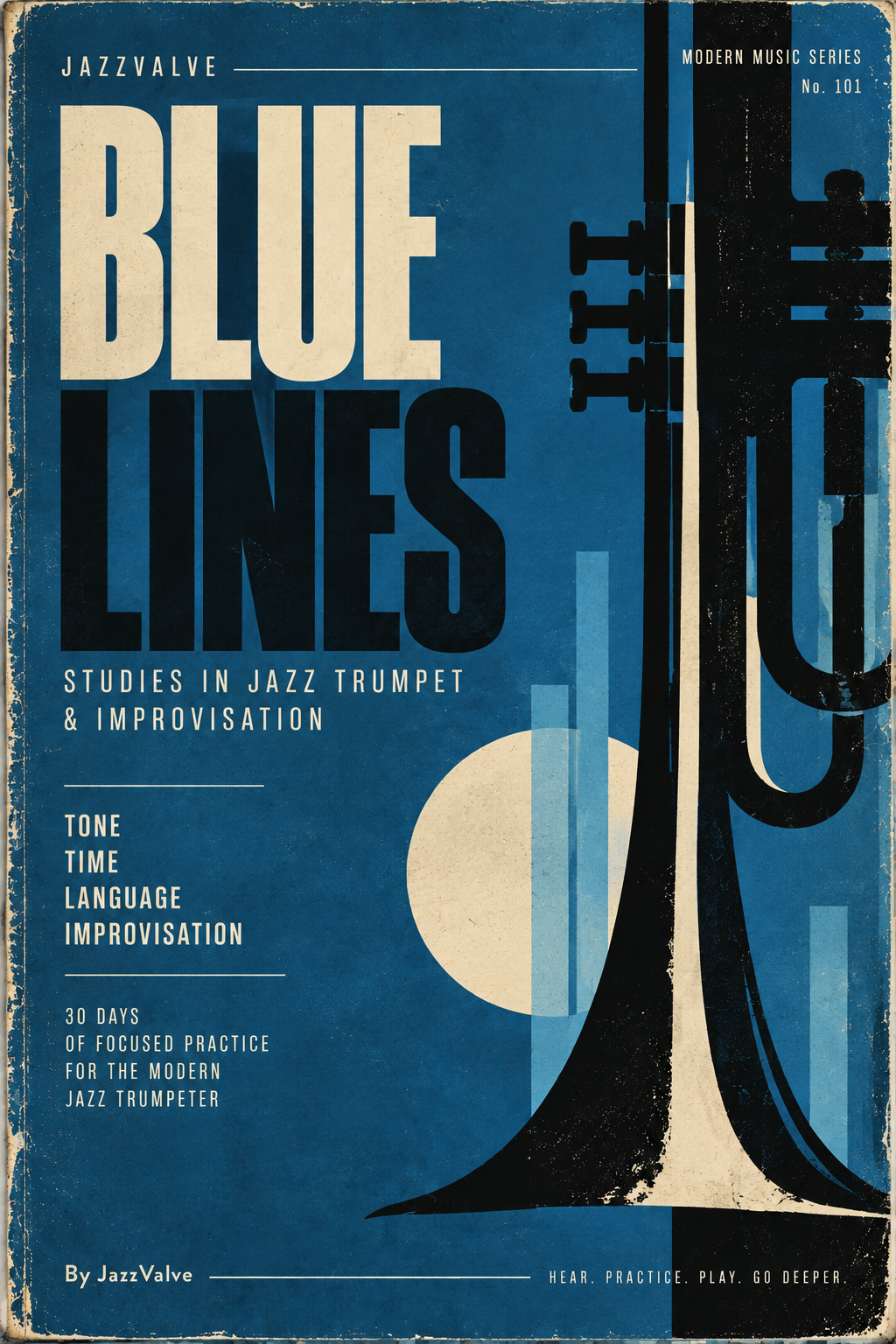
Free trumpet workbook
Blue Lines
Thirty days of focused B♭ trumpet practice: tone, time, jazz language and improvisation.
Email signup required
Get Blue Lines freeTo transcribe a jazz solo for trumpet, you need more than a list of pitches. A useful written transcription shows where the phrases belong in the form, how their rhythms fit the beat, and which details deserve another listen.
Start with one complete chorus that you can hear clearly. This workflow takes you from a recording to a checked written B-flat trumpet part. If matching even a few notes by ear is still difficult, use the first-phrase ear-training lesson first. Here the extra task is organizing and checking a whole chorus on paper.
Choose a manageable chorus and identify the source
Pick a passage with a clear solo line, a tempo you can follow, and a register you can approach comfortably. A sparse chorus is a sensible first project. Difficulty comes from the detail you must hear, not just the number of bars.
Write a source note before transcribing: performer, tune, album or performance, recording link, and the chorus start and end timestamps. Different performances of the same tune can have different keys, introductions and solo lengths. A tune title alone does not identify what you heard.
Listen to the whole solo several times, including music before and after your selected chorus. In his Berklee interview about transcription, Michael Kaplan emphasizes hearing the whole solo's context and checking notes, rhythms, harmony and articulations. His subject is guitar, but those listening checks apply to a written trumpet part too.
JazzValve
Practice This In JazzValve
Open in the app →
Build a bar map before filling the staff
Find the pulse and count the form. Mark the start of your chorus, then number its measures. For a twelve-bar blues, prepare twelve bars; for another form, use its actual length. Do not assume that the first solo note is the first beat of the chorus. A phrase may begin with a pickup or after several rests.
Make a simple working log with three entries for each bar: timestamp, what you hear, and what remains uncertain. An entry might read “bar 5: entrance after beat 1; final pitch uncertain.” Those question marks are useful. They prevent a guess from silently becoming a settled note.
Add chord symbols only from a source or listening check you trust, and label them concert or written pitch. If harmony is uncertain, leave it marked as uncertain while you continue with rhythm. Avoid selecting pitches merely because they would fit your guessed chord.
Make a rhythm-only pass
Tap the beat and speak the phrase rhythm before assigning note names. Locate the attacks, sustained notes and silences. Begin with a single bar, but include a little lead-in and the following downbeat in the audio loop so you can hear its position.
Use a rough rhythm staff or a beat grid. Berklee's Ear Training Fundamentals syllabus includes rhythm-grid work and transcription of rhythms and melodies. The practical order here is an original way to separate the listening tasks; you can alternate rhythm and pitch passes when that is clearer.
For a counting check, consider this original example, not a recorded solo excerpt in 4/4:
- Beat 1: quarter rest.
- Beat 2: two eighth notes.
- Beat 3: quarter note.
- Beat 4: quarter rest.
The total is one plus one plus one plus one: four beats. Two eighth notes together occupy one beat. If the final note continues across a barline, account for its duration on both sides with a tie rather than shifting the next bar's beginning.
For a swing performance, ordinary eighth-note notation may represent a flexible long-short feel. Do not turn every subtle delay into an elaborate new subdivision. Compare the phrase at normal speed and use the swing-eighth lesson to separate the underlying rhythm from its placement.
JazzValve
Practice This In JazzValve
Open in the app →
Add pitches in one clearly labeled system
Read the note and rhythm transcript below. Staff notation requires JavaScript.
Notes, rhythm and playing instructions
- Bar 1: beat 1, quarter rest; beat 2, E4 eighth note, fingering 1+2, sounds D4; beat 2.5, F4 eighth note, fingering 1, sounds E-flat4; beat 3, G4 quarter note, fingering open, sounds F4; beat 4, quarter rest.
Show how an explicitly original rhythm-and-pitch example becomes a written B-flat trumpet part. Steady quarter-note pulse; no invented swing interpretation. Concert pitches in the transcript are references only; play the written pitches on B-flat trumpet. No audio playback or fixed swing ratio is implied.
Choose written B-flat trumpet pitch for the final part. A standard B-flat trumpet sounds a major second below its written notes. Therefore, move a concert pitch up a major second when writing it for trumpet. The UTEP instrument-transposition reference provides the instrument relationship.
Check both the note name and octave:
| Sound heard or shown by a concert-pitch tool | Written B-flat trumpet note |
|---|---|
| B-flat3 | C4 |
| C4 | D4 |
| D4 | E4 |
| E-flat4 | F4 |
| F4 | G4 |
Written C4 is middle C below the treble staff; E4 is the first line and G4 the second line. A recording of a trumpet already sounds at concert pitch. Matching that sound on your own B-flat trumpet and writing the note you finger gives the written part directly; do not transpose that written note again.
For the original rhythm example above, suppose the sounding pitches are D4, E-flat4 and F4. The trumpet part is a quarter rest, E4–F4 as eighth notes on beat 2, G4 as a quarter note on beat 3, then a quarter rest. All three notes and the rhythm are now specified.
Use the B-flat trumpet transposition guide if a tuner, keyboard or notation program makes the pitch labels confusing. Label any temporary concert-pitch sketch clearly so it cannot be mistaken for the finished trumpet part.
Mark expression after the basic notes settle
Listen again for note lengths, accents, connections and releases. Write only what you can support. If a detail remains ambiguous, add a working note instead of filling the page with confident-looking markings.
A notation program can help detect missing beats, but its playback is not the original performance. A mechanically correct bar can still miss an entrance, the end of a note or the character of an accent. Keep returning to the recording at its original speed.
If you slow playback, use a pitch-preserving mode and check that it has not changed the pitch you are matching. You can work below performance tempo without assuming the slowed version captures every detail of the original feel.
Audit one chorus in three separate passes
First, follow your bar numbers while listening without playing. Confirm the chorus begins and ends where you marked it. Check pickups and rests at both boundaries.
Second, clap or speak your written rhythms with the source. Every ordinary 4/4 bar should account for four quarter-note beats, including ties and rests. If you consistently arrive early at the next phrase, inspect the written silence before changing the tempo.
Third, play small comfortable sections and compare pitch, octave and articulation. Rest between attempts. Keep a short list of unresolved places and return to them later, rather than repeatedly guessing the same passage.
Finish by writing one musical observation: perhaps a phrase ends before a chord change, or the player repeats a rhythm with different pitches. That observation gives the notation a purpose beyond completing the page.
Keep the recording citation with your study copy. This lesson does not provide or reproduce a copyrighted solo transcription. For separate original practice material, the free Blue Lines workbook is available with email signup. Your next step is one checked chorus that you can follow, hear and discuss, not an unchecked stack of notes.
JazzValve
Practice This In JazzValve
Open in the app →
Free trumpet workbook
Blue Lines
Thirty days of focused B♭ trumpet practice: tone, time, jazz language and improvisation.
Email signup required
Get Blue Lines freeSources
- Berklee Online: Transcribing Jazz Guitar, interview with Michael Kaplan — https://online.berklee.edu/takenote/transcribing-jazz-guitar-an-interview-with-michael-kaplan/
- Berklee Online: Ear Training Fundamentals syllabus — https://online.berklee.edu/courses/ear-training-fundamentals
- Charles Leinberger, UTEP: Instrument Transpositions for Musical Analysis — https://utminers.utep.edu/charlesl/transpose.html